No transcript available for this episode.
S01:E03
1066: The Year of Three Kings and the Clash that Changed the World
Imagine a year so wild, so chaotic, and so packed with betrayal, invasion, and epic battles that it sounds like a fantasy movie. But this isn’t fiction. This is the year 1066, and the crown of England is up for grabs. Grab your sword and shield, because we are diving headfirst into the Norman Conquest—a historical thriller that changed the English-speaking world forever!
Our story begins in January 1066 with the death of the English King, Edward the Confessor. Edward died without leaving an obvious heir to the throne, creating a massive power vacuum. Instantly, three powerful men raised their hands, ready to fight to the death for the crown.
First, there was Harold Godwinson, the most powerful noble in England. The English council of lords quickly crowned him King Harold II. But across the English Channel, in France, Duke William of Normandy was furious. William claimed that Edward the Confessor had promised him the throne years earlier, and that Harold Godwinson had even sworn a holy oath to support him. To William, Harold was a dirty oath-breaker. Meanwhile, up in Scandinavia, a legendary, giant Viking king named Harald Hardrada decided he should rule England, basing his claim on an old family agreement.
With three kings and only one throne, a bloody collision was inevitable.
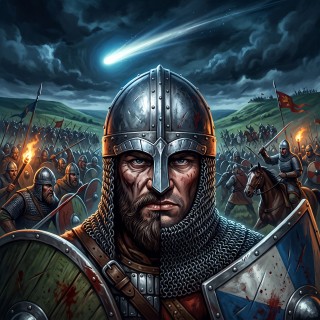
To make things even creepier, a strange blazing star appeared in the sky in April 1066. Today, we know it was Halley’s Comet, but back then, people saw it as a terrifying omen of doom. And doom was indeed coming.
First, the Viking king Harald Hardrada invaded the north of England with a fleet of 300 longships. King Harold Godwinson had to march his army over 185 miles north in just four days—an incredible feat! They caught the Vikings completely by surprise at the Battle of Stamford Bridge. In a brutal, exhausting clash, the English defeated the Vikings, and Hardrada was killed.
But there was no time to celebrate. Just days later, news arrived that Duke William of Normandy had landed his invasion fleet on the southern coast of England. Harold Godwinson’s exhausted, battle-weary army had to turn around and march all the way back down south.
On October 14, 1066, the two armies met near Hastings. This was the moment of truth.
King Harold and his Anglo-Saxons took the top of a hill, forming a legendary ‘shield wall.’ Picture thousands of warriors standing shoulder-to-shoulder, locking their wooden shields together to create an impenetrable wooden fortress. William’s Norman knights charged up the hill again and again, but they could not break through. The Anglo-Saxon axes chopped down horses and men alike. The battle raged for hours, and the Normans began to panic, hearing a rumor that Duke William had been killed.
To prove he was alive, William tore off his helmet, rode in front of his men, and shouted, ‘Look at me! I live, and by God’s help, I shall conquer!’
Then, the Normans used a brilliant, sneaky tactic. They pretended to run away in panic. Seeing the Normans ‘retreat,’ some of the English soldiers broke their shield wall and chased them down the hill. This was a fatal mistake. Once the English were disorganized, the Normans spun around and cut them to pieces.
As the shield wall crumbled, a stray arrow reportedly pierced King Harold right through the eye, killing him instantly. With their leader dead, the English army panicked and fled into the forests. Duke William had won. He marched to London and was crowned King of England on Christmas Day, 1066, earning the nickname we still know him by today: William the Conqueror.
This invasion changed England forever. William replaced the English lords with French-speaking Normans. For centuries, the ruling class of England spoke French, while the common people spoke Old English. Over time, these two languages fused together, which is why modern English has so many words of French origin (like ‘castle’, ‘soldier’, and ‘liberty’). William also built massive stone castles all over the country to keep control, including the famous Tower of London.
In just one year, the Anglo-Saxon era ended, the Viking age drew to a close, and a new, medieval England was born. It all came down to a shield wall, a fake retreat, and a fateful arrow!