S01:E131
Albania: Skanderbeg’s Fortress Kruja – 25 Years of Resistance Against the Sultans (1450)
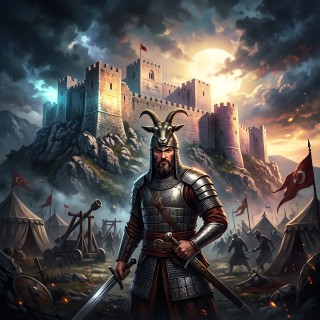
Nestled high in the Albanian mountains, overlooking the plains below like a watchful eagle, stands the fortress of Kruja. In the annals of history, few places embody the spirit of defiance and resilience quite like this ancient stronghold. It was here, in the mid-15th century, that a legend was forged – the legend of Gjergj Kastrioti, better known to the world as Skanderbeg, and his unwavering stand against the might of the Ottoman Empire. For a quarter-century, from roughly 1443 until his death in 1468, Skanderbeg, from his unyielding bastion at Kruja, became the insurmountable bulwark of Christian Europe against the encroaching Ottoman tide.
The year 1450 marked a pivotal moment in this epic struggle. Sultan Murad II, exasperated by the persistent thorn in his side that was Skanderbeg, launched a massive offensive, personally leading an army estimated to be between 100,000 and 150,000 strong. Their objective was clear: capture Kruja, eliminate Skanderbeg, and crush Albanian resistance once and for all. What followed was a siege that would test the limits of human endurance and military genius. Skanderbeg, with a mere 8,000 to 10,000 men, faced an enemy force ten to fifteen times his size. It was a David and Goliath struggle played out on a grand scale.
Kruja itself was a formidable natural fortress, strategically positioned on a steep, rocky outcrop. Its walls, reinforced over centuries, seemed to merge with the very mountainside. Skanderbeg, a military prodigy trained in the Ottoman court before his dramatic return to Albania, understood the art of defense like few others. He did not merely rely on walls; he employed a strategy of guerrilla warfare, ambushes, and lightning raids that constantly harassed and demoralized the besiegers. While Murad’s forces battered the walls with cannons and attempted to starve out the defenders, Skanderbeg’s small, highly mobile forces launched daring sorties from the fortress and surprise attacks on Ottoman supply lines in the surrounding valleys.
Life within Kruja during the siege was a testament to human fortitude. Resources were meticulously managed, morale was kept high through Skanderbeg’s inspiring leadership, and every man, woman, and child played a part in the defense. The psychological warfare was as intense as the physical battles. The Ottomans, confident in their overwhelming numbers, expected a swift victory. Instead, they met with stubborn, unyielding resistance that defied all conventional military logic. Their morale began to sag as the siege dragged on, diseases spread through their vast camp, and their supply lines grew increasingly vulnerable.
Murad II, a seasoned and respected Sultan, found himself in an unprecedented predicament. His vast army, capable of conquering empires, was being held at bay by a small band of Albanians led by a single, brilliant commander. After months of fruitless attempts to breach the fortress and with winter approaching, Murad was forced to make the humiliating decision to lift the siege. He retreated in shame, leaving behind thousands of dead and a significant portion of his war machine. The first great siege of Kruja in 1450 was a monumental victory, not just for Albania, but for the spirit of resistance itself. It demonstrated that courage, strategic brilliance, and an unshakeable will could overcome even the most overwhelming odds.
This triumph solidified Skanderbeg’s legendary status. He became known as the ‘Dragon of Albania,’ a figure of terror to the Ottomans and a beacon of hope for Christian Europe. Kruja became more than just a fortress; it became a symbol – a symbol of Albanian national identity, of unwavering faith, and of the enduring struggle for freedom against tyranny. For another two decades, Skanderbeg continued his extraordinary campaign from Kruja, engaging in countless battles and successfully repelling multiple Ottoman invasions. His resistance, sustained for a quarter-century, bought crucial time for Europe, diverting Ottoman resources and attention away from the heart of the continent.
Even after Skanderbeg’s death, Kruja remained a bastion of resistance, holding out for another ten years before finally falling to the Ottomans in 1478. But by then, the legacy was cemented. The 25 years of resistance, spearheaded from Kruja, had etched Skanderbeg’s name into the annals of military history and secured Albania’s place as a nation forged in the crucible of defiance. Today, the fortress of Kruja stands as a powerful monument, a silent witness to an extraordinary chapter in human history, reminding us that even in the face of insurmountable odds, the human spirit can prevail.