0:00Intro
Blood, Boots, and Borders: The Eternal Anglo-Scottish Rivalry
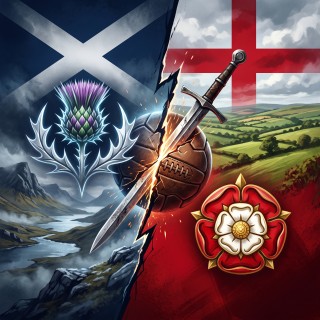
For over a thousand years, a thin, invisible line winding through rugged hills, salt marshes, and windswept rivers has divided the island of Great Britain. This is the Anglo-Scottish border. But the line is far more than mere geography; it is a psychological fault line. The rivalry between England and Scotland is one of the most enduring, complex, and passionate dynamics in human history. From the mud and blood of medieval battlefields to the roaring terraces of modern stadiums, this relationship has morphed from existential warfare into a fierce cultural and sporting duel that still defines the British Isles today.
To understand the roots of this fiery antagonism, one must travel back to the dark ages of the late thirteenth century. Scotland was a sovereign kingdom, but its southern neighbor, England, was ruled by King Edward I—a towering, ruthless monarch known to history as the ‘Hammer of the Scots.’ Edward sought to bring the entire island under his iron heel. His brutal invasions sparked the Wars of Scottish Independence, a chaotic era of cinematic betrayals, guerrilla warfare, and legendary figures. This was the age of William Wallace, the charismatic rebel leader who routed the English at Stirling Bridge, and Robert the Bruce, the cunning nobleman who crowned himself King of Scots. In 1314, at the Battle of Bannockburn, Bruce’s outnumbered spearmen shattered the chivalry of England, securing Scotland’s independence in a triumph that is still sung about today in the Scottish national anthem, ‘Flower of Scotland.’
For centuries, the border remained a lawless ‘Debatable Land’ terrorized by Reivers—gallowglass raiders who stole cattle and burned homes on both sides. Yet, history is fond of irony. In 1603, the Tudor dynasty in England died out, and the English crown was offered to none other than King James VI of Scotland. With the ‘Union of the Crowns,’ a Scottish king rode south to rule England as James I. A century later, in 1707, the political marriage was finalized with the Act of Union, creating the Kingdom of Great Britain. It was not a merger of love, but of cold pragmatism: Scotland was bankrupt after a failed colonizing scheme, and England feared Scotland might ally with Catholic France.
Despite the political union, the underlying friction never truly vanished; it merely changed its uniform. By the nineteenth century, as the industrial revolution transformed both nations, the physical weapons of war were replaced by the leather ball. On November 30, 1872, the world’s very first international association football match took place in Glasgow between Scotland and England. The match ended in a 0-0 draw, but it birthed a sporting rivalry that remains unmatched in its intensity. For Scots, defeating England was—and is—the ultimate vindication, a chance to slay the Goliath of the south. This sentiment gave rise to the ‘Anyone But England’ (ABE) phenomenon, where Scottish fans cheerfully support whichever country is playing against the English team.
This athletic warfare is not confined to football. In rugby union, the annual clash between the two nations for the Calcutta Cup is played with a gladiatorial intensity that defies the friendly nature of modern sport. To the English, Scotland is often viewed as the rebellious, hot-tempered younger sibling—frequently underestimated. To the Scots, England is the domineering, self-absorbed elder sibling who takes up all the oxygen in the room.
In the twenty-first century, the rivalry has once again taken on a serious political edge. The devolution of power to the Scottish Parliament in 1999 gave Scotland a renewed political voice, culminating in the historic 2014 Independence Referendum. Though Scotland voted 55% to 45% to remain in the United Kingdom, the subsequent Brexit referendum in 2016 exposed a profound divide: every single constituency in Scotland voted to remain in the European Union, while England voted to leave. Today, the debate over Scotland’s future and its relationship with Westminster continues to simmer, proving that the ancient border is as politically alive as ever.
Ultimately, the Anglo-Scottish rivalry is a masterclass in how shared history can both unite and divide. It is a relationship forged in conflict, sustained by proximity, and celebrated through a shared, albeit fiercely competitive, culture. Whether on the grass of Murrayfield, the pitch of Wembley, or the floor of Parliament, the battle for British supremacy is a story that is far from over.