0:00Intro
Blood, Iron, and Destiny: The Epic Saga of the Texas Revolution
In the mid-1830s, the vast, sun-baked expanses of Tejas—then a northern province of the young Mexican Republic—became the crucible for one of the most explosive military conflicts in North American history. The Texas War of Independence was not merely a clash of armies; it was a violent collision of cultures, political ideologies, and territorial ambitions that redrew the map of the continent forever.
To understand the spark that ignited this revolution, one must look back to the 1820s, when a newly independent Mexico invited American settlers to populate its sparsely inhabited northern frontier. Under the Empresario system, leaders like Stephen F. Austin brought thousands of families into Texas. These settlers, known as Texians, agreed to become Mexican citizens, convert to Catholicism, and abide by Mexican law. However, cultural and political divisions soon flared. The Texians brought with them Anglo-American concepts of federalism, local governance, and, critically, the practice of chattel slavery—which Mexico had explicitly abolished in 1829.
Tensions reached a boiling point in 1835 when General Antonio López de Santa Anna dissolved the Mexican Congress, revoked the liberal Mexican Constitution of 1824, and centralized power into a military dictatorship. Viewing Santa Anna as a tyrant stripping away their constitutional rights, both Anglo Texians and native Tejanos (Mexican-born Texans who favored regional autonomy) decided to resist Centralist rule by force.
The first armed conflict erupted on October 2, 1835, in the small settlement of Gonzales. When Mexican troops arrived to reclaim a small bronze cannon previously loaned for protection against Comanche raids, the townsfolk refused to surrender it. Instead, they raised a homemade flag featuring a black cannon beneath a simple, audacious challenge: “Come and Take It.” After a brief skirmish, the Mexican forces withdrew. The revolution had officially begun.
By early 1836, Texas had formally declared its full independence, establishing a provisional government and naming Sam Houston as commander-in-chief of the military. Furious at what he viewed as a treasonous rebellion orchestrated by foreign usurpers, Santa Anna personally marched north at the head of a massive army of over 6,000 soldiers, determined to crush the revolt with absolute ruthlessness.
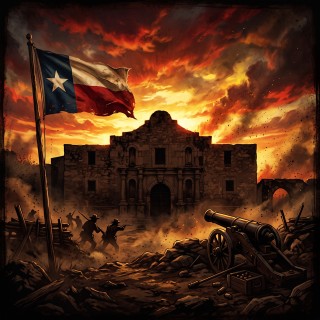
This vengeful campaign led directly to the legendary Siege of the Alamo in San Antonio. From February 23 to March 6, 1836, a garrison of roughly 185 to 260 defenders—including iconic frontier figures like Davy Crockett, Jim Bowie, and the young commander Lieutenant Colonel William B. Travis—held out against thousands of Mexican troops inside an unfinished Franciscan mission. For 13 agonizing days, Travis refused to retreat, dispatching letters pleading for reinforcements while declaring “Victory or Death.” On the cold morning of March 6, Santa Anna ordered a brutal, all-out assault. The defenders fought valiantly in hand-to-hand combat before being totally overwhelmed. Santa Anna showed no mercy, ordering all surviving combatants executed and their bodies burned in mass pyres.
Just weeks later, tragedy struck again at Goliad, where over 300 surrendered Texian soldiers under Colonel James Fannin were executed in cold blood on Santa Anna’s direct orders. Rather than quelling the rebellion through terror, these atrocities backfired completely. They united the Texians, transformed their struggle into a crusade for survival, and birthed thunderous battle cries that rang across the prairies: “Remember the Alamo! Remember Goliad!”
The decisive climax came on the afternoon of April 21, 1836, along the marshy banks of the San Jacinto River. Sam Houston, having conducted a strategic retreat to gather troops and wait for an opening, launched a daring surprise attack while Santa Anna’s army was taking an afternoon siesta. In an astonishing 18-minute onslaught, Houston’s force of roughly 900 men swept through the Mexican camp, completely annihilating and routing the surprised forces.
Santa Anna was captured the following day hiding in high grass, disguised as a common soldier. In exchange for his life, he signed the Treaties of Velasco, ordering all remaining Mexican military forces to retreat south of the Rio Grande and acknowledging Texas as an independent nation. Though the Mexican government in Mexico City later repudiated the treaties, claiming Santa Anna had signed them under duress, Texas had effectively secured its independence. For nearly a decade, the region existed as the sovereign Lone Star Republic before being annexed into the United States in 1845—an event that would directly trigger the Mexican-American War and reshape the North American continent.