0:00Intro
Echoes in the Ice: The Teutonic Knights’ Eastern Crusade and the Battle of Lake Peipus, 1242
The 13th century in the Baltic region was a crucible of faith, conquest, and profound geopolitical shifts. At its heart lay the relentless expansion of Western European crusader orders, chief among them the formidable Teutonic Knights. While their name often conjures images of Prussia, their presence stretched across the eastern Baltic, deeply imprinting itself on the lands that would become Latvia and Estonia. In 1242, their ambitious eastward push met a dramatic and chilling halt on the frozen expanse of Lake Peipus, an event that would resonate through the annals of history, even as their influence continued to shape the region from strongholds like Riga.
Born from the fervent religious spirit of the Crusades, the Teutonic Order emerged in the Holy Land as a monastic military order. By the early 13th century, with crusader enthusiasm waning in the Middle East, their focus shifted to the ‘Northern Crusades’ – campaigns aimed at Christianizing the remaining pagan populations of the Baltic, primarily the Old Prussians, Livonians, and Estonians. Their methods were often brutal, combining religious conversion with territorial expansion, carving out a monastic state in the process. In Livonia (present-day Latvia and Estonia), their power was consolidated through the merger with the Livonian Brothers of the Sword in 1237, forming the Livonian Order, a semi-autonomous branch of the Teutonic Knights. This union made them a formidable force, rapidly extending their control and establishing strategic castles and settlements, with Riga serving as a critical port city and administrative center.
Riga, founded in 1201 by Bishop Albert of Livonia, swiftly grew into a pivotal hub for trade and crusader operations. It was not just a military base but a burgeoning Hanseatic city, a gateway to the vast resources of the East and a springboard for further territorial ambitions. From Riga, the Order exerted considerable influence, constructing impressive fortifications like Riga Castle (though much of its current form is later, the site was crucial) and shaping the nascent Livonian state. However, their drive for expansion inevitably brought them into conflict with established powers to the east, most notably the prosperous and powerful Russian principality of Novgorod, led by the legendary Prince Alexander Nevsky.
By the early 1240s, the Teutonic Knights, along with their Danish and Estonian crusader allies, had pushed their territorial claims deep into lands bordering Novgorod, capturing the crucial cities of Izborsk and Pskov. This aggressive encroachment threatened the very sovereignty and Orthodox Christian faith of the Russian lands. Alexander Nevsky, a military leader of extraordinary skill and foresight, understood the grave danger posed by the crusaders’ advance. In the winter of 1242, after recapturing Pskov, he positioned his forces for a decisive confrontation. The stage for an epic showdown was set on the vast, frozen surface of Lake Peipus (also known as Lake Chudskoye).
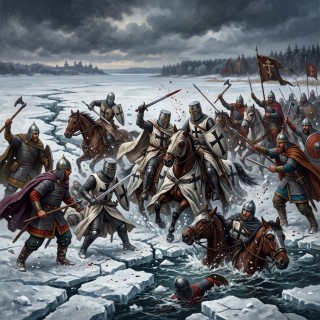
On April 5, 1242, the two armies clashed in what would become famously known as the Battle on the Ice. The Teutonic Knights, confident in their heavy cavalry and the devastating power of their ‘iron pig’ or ‘wedge’ formation – a tightly packed, armored column designed to smash through enemy lines – charged across the frozen lake. Nevsky, however, had anticipated this tactic. He deployed his archers and light infantry along the center, with his elite cavalry concealed on the flanks, deliberately allowing the Teutonic wedge to penetrate his lines. As the crusaders became bogged down in the Russian center, Nevsky’s flanking forces enveloped them, trapping the heavy knights. The sheer weight of the armored men and horses, combined with the softening ice of early spring, proved fatal. Accounts, though exaggerated, speak of the ice cracking and giving way under the strain, sending scores of crusaders to their icy deaths. The battle was a catastrophic defeat for the Teutonic Order, with heavy losses in men and prestige.
The Battle on the Ice marked a crucial turning point. It decisively halted the Teutonic Knights’ eastward expansion into Russian lands, securing Novgorod’s western borders and establishing a de facto boundary between the Catholic West and the Orthodox East that would largely endure for centuries. For Alexander Nevsky, it cemented his legacy as a national hero and savior of Russia. However, this defeat did not signal the end of the Teutonic Order’s influence in the Baltics. While their eastern ambitions were checked, they consolidated their power in Livonia, retaining control over strategic cities like Riga and vast swathes of territory. The Order shifted its primary expansionary focus southward, into Prussia, intensifying its campaigns against the pagan Old Prussians, which ultimately led to the establishment of their powerful Monastic State.
Thus, while the ice of Lake Peipus bore witness to a chilling defeat in 1242, the Teutonic Knights’ presence in Livonia, headquartered in Riga, continued to shape the region’s destiny for centuries. Their architectural legacy, administrative structures, and cultural imprint on Latvia and Estonia remain profound, a stark reminder of an era when faith and the sword forged new nations and redrew the map of Eastern Europe. The Battle on the Ice stands as a dramatic testament to the limits of ambition and the resilience of a people defending their land and identity against overwhelming forces.