Echoes of the Mediterranean: The Phoenicians, Carthaginians, and Their Enduring Legacy
Have you ever wondered about the ancient mariners who reshaped the landscape of the Mediterranean, establishing trade routes, founding powerful cities, and leaving an indelible mark on history? We’re talking about the Phoenicians and their formidable successors, the Carthaginians. Their story is one of innovation, ambition, and ultimately, a tragic struggle against a rising superpower.
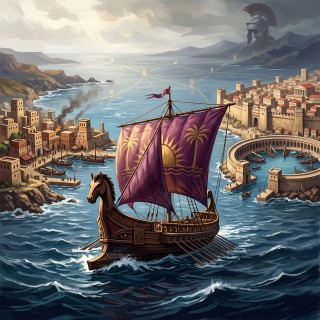
Who were the Phoenicians? Emerging from the Levant, specifically from a narrow coastal strip corresponding to modern-day Lebanon, Syria, and Israel, the Phoenicians were not a unified empire in the traditional sense. Instead, they were a collection of independent city-states, such as Tyre, Sidon, and Byblos, bound by a common language, culture, and an unparalleled mastery of the sea. Their origins can be traced back to around 3200 BCE, but their golden age flourished from roughly 1200 BCE to 300 BCE. They were the ultimate entrepreneurs of the ancient world. Lacking vast agricultural lands, they turned their gaze seaward, becoming master shipbuilders, navigators, and traders. Their ships, renowned for their speed and durability, traversed the entire Mediterranean, reaching as far as the Atlantic coast of Africa and possibly even Britain. They established a vast network of trading posts and colonies, exchanging goods like cedar wood, purple dye (Tyrian purple, a highly prized luxury), glass, metalwork, and even exotic animals. More than just merchants, the Phoenicians were cultural conduits. They are credited with developing the first widely used alphabetic writing system, a revolutionary innovation that profoundly influenced subsequent alphabets, including Greek and Latin, and thus, the very foundation of Western literacy.
From these Phoenician roots sprang one of their most successful colonies: Carthage. Founded by Tyre in the 9th century BCE on the coast of modern-day Tunisia, Carthage initially served as a trading post. However, as the Phoenician homeland fell under the sway of successive empires – first the Assyrians, then the Babylonians, and finally the Persians – Carthage began to assert its independence and expand its own influence. By the 6th century BCE, Carthage had evolved into a formidable maritime and commercial power, eclipsing its mother city and establishing its own vast Carthaginian Empire. This empire encompassed territories across North Africa, Spain, Sicily, Sardinia, and Corsica. Carthage was a truly cosmopolitan city, boasting a magnificent harbor, thriving markets, and a highly advanced society. Their military was formidable, relying heavily on a professional army composed of mercenaries, led by brilliant generals, most famously Hannibal Barca.
What became of them? The fate of the Phoenicians and Carthaginians diverged significantly. The original Phoenician city-states, after centuries of independent prosperity and then periods of vassalage to larger empires, gradually lost their distinct identity. Their culture was absorbed into the Hellenistic and then Roman worlds. Their language, Phoenician, slowly gave way to Aramaic and Greek, and their vibrant cities became Roman provincial towns. While their direct political influence waned, their technological and cultural contributions, particularly the alphabet, continued to shape civilizations.
Carthage, however, met a more dramatic and ultimately tragic end. Its expansion brought it into direct conflict with a rising power across the Strait of Messina: Rome. The ensuing series of conflicts, known as the Punic Wars (from “Punicus,” the Latin word for Phoenician), were epic struggles for control of the Western Mediterranean. The First Punic War (264-241 BCE) saw Carthage lose Sicily to Rome. The Second Punic War (218-201 BCE) was the most famous, featuring Hannibal’s audacious march over the Alps and his stunning victories at Cannae and Lake Trasimene. Despite Hannibal’s brilliance, Rome’s superior manpower, resilience, and strategic depth ultimately prevailed, forcing Carthage to relinquish its territories in Spain and pay massive indemnities. The Third Punic War (149-146 BCE) was a brutal and conclusive affair. Driven by a vengeful senator Cato the Elder, who famously ended every speech with “Carthago delenda est!” (Carthage must be destroyed!), Rome besieged and utterly annihilated Carthage. The city was razed to the ground, its fields supposedly sown with salt (though this particular detail is likely a later embellishment), and its remaining inhabitants sold into slavery. The Carthaginian civilization, as an independent entity, ceased to exist. Roman Carthage later rose on the same site, but it was a Roman city, not a Punic one.
While their political power vanished, the legacy of the Phoenicians and Carthaginians endures. Their pioneering maritime skills laid the groundwork for future naval powers. Their alphabetic script revolutionized communication. Their trade networks fostered cultural exchange across vast distances. And the epic clashes between Carthage and Rome forever shaped the course of Western history. Though no longer visible as distinct nations, their echoes resonate in the very fabric of our modern world.