S01:E59
Empires of Bronze and Earth: The Splendor of Pre-Colonial Nigeria
Long before European cartographers drew arbitrary borders across the African continent, the region that is today Nigeria was a thriving crossroads of sophisticated civilizations, visionary statecraft, and peerless artistic mastery. For thousands of years, diverse cultures flourished along the Niger and Benue rivers, developing intricate political systems, vast trans-Saharan trade networks, and metallurgical techniques that rivaled—and often surpassed—those of contemporary Europe. Far from an untamed wilderness, pre-colonial Nigeria was an awe-inspiring mosaic of fortified metropolises, divine kingdoms, and artistic golden ages.
The deep antiquity of this artistic lineage is exemplified by the Nok culture, which thrived from roughly 1500 BCE to 500 CE in the central Nigerian plateau. The Nok were revolutionary iron-smelters and master sculptors, creating dramatic, near life-sized terracotta figures characterized by piercing triangular eyes, elaborate coiffures, and ornate jewelry. Centuries later, in the southeastern forested region, the 9th-century site of Igbo-Ukwu revealed another apex of technical genius. Long before the European Renaissance, Igbo-Ukwu artisans perfected the lost-wax casting technique (cire perdue), producing exquisitely detailed bronze vessels, roped pots, and ceremonial regalia adorned with delicate motifs of beetles, snails, and intricate geometric filigree.
To the southwest, the spiritual heart of the Yoruba people beat in Ile-Ife. Regarded by tradition as the cradle of humanity, Ife was a magnificent urban center renowned for its sacred paving stones and courtyard architecture. Between the 12th and 14th centuries, Ife sculptors achieved a zenith of naturalism with their copper alloy and terracotta portrait heads. When German explorer Leo Frobenius encountered these hyper-realistic sculptures in 1910, his racial biases led him to concoct the bizarre theory that he had stumbled upon the lost city of Atlantis, unable to accept that Black African artists had created works of such sublime anatomical precision and serene majesty.
From the cultural womb of Ife arose the Oyo Empire, a dominant military and political superpower fueled by legendary cavalry forces, skilled diplomatic corps, and an ingeniously balanced constitution. The Alaafin (emperor) did not rule with unchecked tyranny; his power was meticulously checked by the Oyomesi, a supreme council of state, ensuring a sophisticated system of constitutional checks and balances long before modern Western democracies codified such principles.
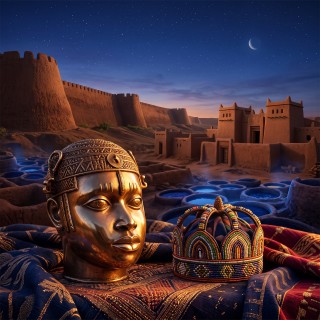
Further south, the rainforest parted for the monumental Kingdom of Benin (the Edo Kingdom). Here stood one of the greatest engineering feats of the pre-industrial world: the Walls of Benin. Consisting of a massive network of earthen ramparts and deep moats spanning over 16,000 kilometers, these defensive earthworks enclosed an estimated 6,500 square kilometers of communal land—four times the length of the Great Wall of China and requiring an estimated 150 million hours of earthmoving. The city itself featured wide streets lit at night by palm-oil lanterns, clean modular housing, and the grand palace of the Oba (King). The palace walls were famously clad in the renowned Benin Bronzes (actually brass and bronze plaques and freestanding busts), which served not merely as decoration, but as an enduring visual archive documenting court rituals, diplomatic triumphs, royal lineages, and divine cosmology.
Simultaneously in the northern savannahs, the Hausa City-States—including Kano, Katsina, and Zaria—flourished as global trading hubs and centers of Islamic scholarship. Kano was celebrated across the Mediterranean for its famous indigo dye pits, finely woven textiles, and leathergoods so supple that when traded north, they were mistakenly labeled ‘Moroccan leather.’ Meanwhile, the Kanem-Bornu Empire maintained sophisticated diplomatic relations with North Africa and the Ottoman Empire, commanding respect across the Islamic world.
These kingdoms were vibrant, dynamic societies of high culture, profound philosophical traditions, and staggering material achievements. When British imperial forces launched violent expeditions—most infamously the punitive sack and looting of Benin City in 1897—they were not encountering a primitive society, but systematically dismantling an advanced world of monumental architecture, political genius, and immortal art.