Estonia: The Singing Revolution – Choirs Against Soviet Tanks (1988)
The year is 1988. The air in Soviet-occupied Estonia crackles not with the usual tension of communist rule, but with an electrifying, almost defiant, melody. This is not a conventional revolution; there are no armed militias, no barricades of stone and fire. Instead, the weapons are voices, the ammunition is song, and the battleground is the human spirit.
For decades, Estonia, like its Baltic neighbors Latvia and Lithuania, had been swallowed by the Soviet Union. Its culture, language, and national identity were systematically suppressed. Yet, beneath the veneer of communist conformity, a powerful current of national pride flowed, sustained by a deep love for song. Choral singing was not merely a hobby in Estonia; it was a revered tradition, a cornerstone of national identity, reaching back to the first Song Festival in 1869.
As Mikhail Gorbachev’s policies of Glasnost (openness) and Perestroika (restructuring) began to ripple across the Soviet empire, a window of opportunity, however narrow, creaked open. Estonians, ever resourceful, seized it not with political rallies, but with something far more profound: song. The traditional Song Festivals, once carefully controlled by the Soviet authorities, began to transform into spontaneous gatherings of unprecedented scale and passion.
In the summer of 1988, a series of mass demonstrations, often disguised as song festivals, erupted across Estonia. Tens of thousands, then hundreds of thousands, gathered on the historic Tallinn Song Festival Grounds, a vast amphitheater designed to hold immense choirs. What started as performances of traditional folk songs and hymns quickly evolved into the bold and open singing of forbidden patriotic anthems. These were songs that had been banned for nearly 50 years, their melodies passed down through generations in hushed tones, now sung with booming, unified voices.
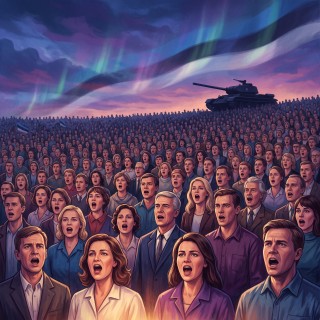
Imagine the scene: a sea of people, perhaps 300,000 strong – nearly a third of Estonia’s population – standing shoulder to shoulder, their voices rising in a powerful crescendo. The Soviet authorities, accustomed to quashing dissent with brute force, found themselves in an unprecedented predicament. How do you confront a revolution waged with song? How do you silence hundreds of thousands of voices without inviting international condemnation and igniting an even greater firestorm?
Initially, Soviet forces were present, their tanks and armored personnel carriers looming on the peripheries, their soldiers armed and watchful. The tension was palpable. Yet, the Estonians sang on, their courage fueled by the sheer power of their collective voice. They sang ‘Mu isamaa on minu arm’ (My Fatherland Is My Love), an unofficial national anthem that embodied their deepest hopes and longings for freedom. They sang with tears in their eyes, with defiant smiles, and with an unwavering belief in the power of their shared heritage.
The Singing Revolution was more than just a series of protests; it was a profound act of psychological warfare. It demonstrated to the world, and more importantly, to Moscow, that the Estonian people were united, their spirit unbroken, and their desire for independence unyielding. It was a testament to the idea that even in the face of overwhelming military might, cultural expression could become a potent weapon.
The international community watched with bated breath. The images of hundreds of thousands of Estonians singing for freedom resonated globally. The sheer peacefulness of the movement, combined with its immense scale, made it impossible for the Soviet Union to justify a violent crackdown without severe international repercussions.
By 1991, as the Soviet Union teetered on the brink of collapse, Estonia’s persistent, vocal demands for independence, amplified by the Singing Revolution, bore fruit. On August 20, 1991, Estonia declared its full independence. The choirs had, in a sense, triumphed over the tanks. The Singing Revolution stands as a unique and inspiring chapter in modern history, a powerful reminder that freedom can sometimes be won not with bullets, but with harmony; not with violence, but with the unwavering power of a people united in song.