No transcript available for this episode.
S01:E91
Feathered Fury: The Unlikely Victory of the Emus in Australia’s Bizarre War
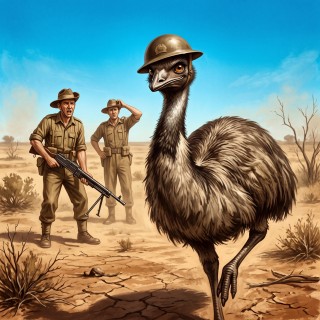
In the annals of military history, tales of tactical brilliance, overwhelming force, and decisive victories are common. But nestled amongst these accounts of human triumph lies a peculiar, almost unbelievable chapter: the Great Emu War of 1932. This was not a war against a foreign power, nor a civil uprising, but a desperate and ultimately humiliating conflict waged by the Australian military against an army of 20,000 crop-destroying emus.
The setting was the Campion district of Western Australia, a sun-baked landscape where struggling farmers, already grappling with the economic hardships of the Great Depression, faced an additional, feathered menace. A massive migration of emus, driven by drought and a quest for food, descended upon their fledgling wheat crops. The birds, large, flightless, and surprisingly resilient, were devouring the precious harvest, pushing already beleaguered farmers to the brink of ruin. Appeals to the government for assistance were met with an extraordinary response: the deployment of soldiers armed with heavy machine guns.
Leading this unusual military campaign was Major G.P.W. Meredith of the Royal Australian Artillery, equipped with two Lewis automatic machine guns and 10,000 rounds of ammunition. His mission, as he saw it, was straightforward: decimate the emu population and save the crops. What unfolded, however, was a masterclass in avian evasion and an abject lesson in the futility of conventional warfare against an unconventional foe.
The initial encounters were, to put it mildly, far from successful. The emus, despite their size, proved to be remarkably agile. They would scatter at the first sign of danger, their seemingly uncoordinated movements actually a highly effective defense mechanism. Attempts to herd them into killing zones were consistently thwarted by their ability to break formation and disperse. Major Meredith and his men, accustomed to stationary targets or predictable human adversaries, found themselves battling a foe that seemed to defy all military doctrine.
Machine guns, designed for rapid-fire devastation, were rendered largely ineffective. The birds were often too spread out, and their speed made accurate targeting a frustrating challenge. Major Meredith lamented, ‘If we had a military division with the bullet-carrying capacity of these birds it would face any army in the world… They can face machine guns with the invulnerability of tanks.’ The soldiers, despite their training and firepower, were outmaneuvered, outsmarted, and ultimately outrun by their feathered adversaries. The cost of ammunition per emu killed was astronomical, and the initial optimistic reports quickly gave way to a growing sense of exasperation and ridicule from the press.
Several strategies were attempted. Mobile patrols in trucks were deployed, but the rough terrain and the emus’ erratic movements made sustained pursuit nearly impossible. Ambushes were set, only for the birds to bypass them entirely. At one point, Major Meredith even attempted to mount a machine gun on a truck, hoping to create a mobile firing platform, but this proved equally fruitless due to the vehicle’s inability to keep pace with the birds on uneven ground.
The ‘war’ lasted for several weeks, marked by brief periods of intense, albeit largely ineffective, skirmishes. Public opinion, initially supportive, began to turn, with newspapers gleefully reporting on the military’s embarrassing failure. The futility of the operation became undeniable. By December 1932, the official campaign was called off. Major Meredith reported that only a few hundred emus had been killed, a mere fraction of the estimated 20,000. The cost of the ammunition expended far outweighed the damage the emus inflicted, and the military’s reputation took a significant hit.
The Great Emu War stands as a comical yet poignant reminder that nature, even in its most seemingly innocuous forms, can present an insurmountable challenge. It exposed the limitations of human technology and strategy when faced with a resilient, unpredictable, and numerous adversary. The emus, driven by instinct and a thirst for survival, had, against all odds, decisively won their peculiar war against humanity, cementing their place in history as unlikely victors in one of Australia’s most bizarre conflicts.