No transcript available for this episode.
S01:E44
How Paranoia and the Great Game Triggered Britain’s Greatest Colonial Disaster
In the mid-19th century, a colossal, quiet war of shadows was fought across the vast deserts, frozen mountain passes, and grand courts of Central Asia. Known as the “Great Game,” this geopolitical rivalry pitted the world’s greatest land empire, Tsarist Russia, against the world’s dominant maritime empire, Great Britain. At the heart of British anxiety lay a single, obsessive fear: that Russia’s relentless southward expansion would eventually spill over the Hindu Kush mountains, breach the northern gates of Afghanistan, and strip Britain of its crown jewel—India.
This rampant imperial paranoia peaked in the late 1830s. In Kabul, Emir Dost Mohammad Khan ruled over a fragile, tribal realm. Desperate to secure his throne against regional rivals, Dost Mohammad sought external alliances. When a charismatic young Russian officer named Jan Vitkevich arrived in Kabul in 1837 carrying diplomatic overtures from Tsar Nicholas I, British intelligence panicked. Despite Dost Mohammad’s actual preference for an alliance with London, British officials convinced themselves that Afghanistan was falling irrevocably under Moscow’s sphere of influence.
Lord Auckland, the Governor-General of India, determined that a preemptive strike was necessary. His goal was straightforward yet disastrously hubristic: march into Afghanistan, depose Dost Mohammad, and replace him with Shah Shujah, a deposed former ruler who would serve as a compliant British puppet.
In 1839, the “Army of the Indus”—a sprawling host of 20,000 British and Indian troops accompanied by an astonishing 38,000 camp followers, complete with thousands of camels carrying fine wines, fine china, and luxury tents—marched across the treacherous mountain passes. Initially, the invasion went remarkably well. Kandahar fell without a fight, followed by the storming of the formidable fortress of Ghazni. By August 1839, Shah Shujah was restored to the throne in Kabul, and Dost Mohammad eventually surrendered, sent into exile in India.
To the British leadership, it appeared to be a brilliant, cheap victory. But the victory was an illusion. Shah Shujah was deeply disliked by his subjects, viewed as a traitor who relied on foreign infidel bayonets to retain power. Meanwhile, the British forces made a fatal error: believing the country was pacified, they moved out of the defensible Bala Hissar fortress and settled into low-lying, unfortified cantonments outside Kabul, surrounded by hills held by hostile tribes. Worse still, officers brought their wives and children, creating a bizarre sense of Victorian domesticity on hostile soil.
By late 1841, financial pressures forced the British administration to cut political subsidies paid to local Pashtun tribes to keep the strategic mountain passes open. Outraged and starving, the tribes revolted. Led by Akbar Khan, the charismatic son of the deposed Dost Mohammad, Afghan fighters launched a fiercely organized rebellion.
In November 1841, the British political resident, Sir Alexander Burnes, was hacked to death by a mob in Kabul. Weeks later, Sir William Macnaghten, the chief diplomat, was murdered during a desperate negotiation with Akbar Khan. Command of the British garrison fell to General William Elphinstone, an elderly, gout-ridden officer crippled by indecision.
Surrounded and low on supplies, Elphinstone negotiated a surrender. In exchange for safe passage to the nearest British garrison at Jalalabad, 90 miles away, the British agreed to abandon Kabul. On January 6, 1842, a column of 4,500 soldiers and 12,000 civilians marched out of the city directly into a brutal winter blizzard.
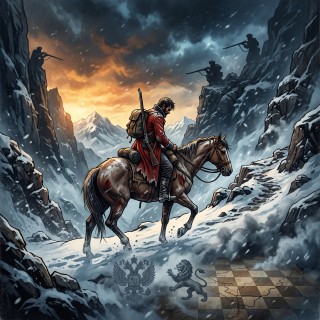
The promised safe passage was a cruel fiction. As the frozen, demoralized column crept into the narrow, claustrophobic Khurd Kabul Pass, Afghan tribesmen ambushed them from the high cliffs. Over the next seven days, the retreat descended into sheer horror. Frostbite, starvation, and ruthless sniper fire annihilated the column step by step. Hundreds froze to death where they sat; others were mercilessly cut down in ambush after ambush.
On January 13, 1842, a solitary, bleeding figure riding a dying horse stumbled up to the gates of Jalalabad. It was Dr. William Brydon. When asked where the army was, he grimly replied, “I am the army.” While a few dozen British officers, women, and children survived as hostages, virtually the entire force of 16,000 people had been wiped out.
The massacre was the worst military catastrophe in British colonial history up to that point. Although Britain launched a punitive “Army of Retribution” later that year to burn Kabul’s grand bazaar and rescue hostages, the strategic defeat was absolute. Realizing Afghanistan was ungovernable, the British withdrew entirely, and Dost Mohammad returned to Kabul to reclaim his throne. The war cost thousands of lives, millions of pounds, and utterly shattered the myth of British invincibility across Asia—all driven by an ungrounded fear of a Russian invasion that never was.