
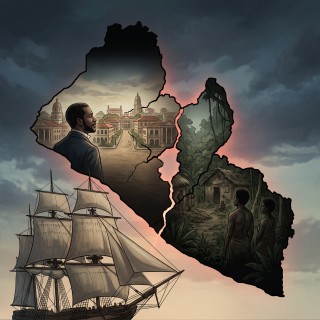
Inverted Freedom: The Liberian Experiment
The year is 1822. A ship, funded by the American Colonization Society (ACS), sets sail across the Atlantic, its cargo not spices or gold, but hope, fear, and a profound paradox. On board are formerly enslaved African Americans, promised a new life, a new nation, and most significantly, a new freedom – in Africa. This was the genesis of Liberia, a nation born of an ideology both noble and deeply flawed, an experiment in ‘inverted freedom’ that continues to resonate today.
The ACS, a peculiar coalition of abolitionists, slaveholders, and politicians, harbored varied motivations. Some genuinely believed in a dignified repatriation for freedmen, a chance to escape the pervasive racism of the United States. Others saw it as a convenient solution to the ‘problem’ of free Black populations, fearing their influence on enslaved people. This inherent conflict in its founding principles would forever stain Liberia’s early years and shape its trajectory.
Upon arrival, the American settlers, often referred to as Americo-Liberians, encountered a land already inhabited by numerous indigenous ethnic groups with established societies, languages, and cultures. The very notion of ‘establishing’ a nation here, without genuine consultation or integration, immediately sowed the seeds of future discord. The Americo-Liberians, despite their own history of oppression, often adopted a colonial mindset, viewing the indigenous populations as ‘backward’ and in need of ‘civilization.’ This created a rigid social hierarchy, with the Americo-Liberians at the apex, controlling political power, economic resources, and social influence.
The early decades were fraught with challenges. Disease, hostile encounters with indigenous tribes defending their ancestral lands, and internal squabbles threatened the nascent colony’s survival. Yet, bolstered by American aid and a fierce determination to prove their capacity for self-governance, Liberia declared its independence in 1847, becoming the first independent republic in Africa. This was a moment of immense pride for many, a beacon of hope for Black people worldwide, demonstrating the potential for self-determination.
However, the ‘inverted freedom’ began to manifest with increasing clarity. The very people who had sought freedom from oppression in America became, in many ways, oppressors themselves. The Americo-Liberian elite, a minority of the population, maintained a political system that disenfranchised and marginalized the vast indigenous majority. Land ownership, political representation, and economic opportunities were largely restricted, leading to growing resentment and a deepening chasm between the two groups.
Economic development was largely driven by rubber plantations and mining concessions, often exploited by foreign companies with little benefit trickling down to the indigenous population. Forced labor, sometimes euphemistically called ‘recruitment,’ became a dark stain on Liberia’s human rights record, echoing the very systems the settlers had fled. The international community, while recognizing Liberia’s independence, often turned a blind eye to these internal injustices.
This simmering discontent eventually erupted. Decades of inequality, political repression, and economic disparity culminated in a military coup in 1980, led by Samuel Doe, an indigenous Krahn man. This event marked the end of Americo-Liberian dominance and ushered in a period of unprecedented instability, including two devastating civil wars that tore the nation apart, claiming hundreds of thousands of lives and displacing millions.
Liberia’s journey from an ambitious experiment to a nation scarred by conflict offers profound lessons. It highlights the complexities of identity, the dangers of replicating oppressive systems, and the enduring struggle for true, equitable freedom. Today, Liberia is on a path of reconstruction, grappling with its history and striving for genuine reconciliation. The echoes of ‘inverted freedom’ still resonate, reminding us that liberation is not merely the absence of chains, but the presence of justice, equality, and shared dignity for all citizens.