No transcript available for this episode.
S01:E129
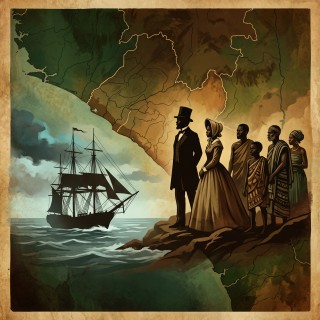
Liberia: The Return of the Liberated – Americo-Liberians and the Conflict for the Pepper Coast (1847)
The year 1847 marks a pivotal moment in the complex and often tragic history of Liberia, a nation born from the aspirations of freedom and the bitter realities of colonialism. It was in this year that the Republic of Liberia officially declared its independence, a bold move by a community of repatriated African Americans and liberated slaves, now known as Americo-Liberians, who sought to forge a new destiny on the West African coast. This was not merely the birth of a nation; it was the unfolding of a grand, fraught experiment, fraught with contradictions, noble intentions, and ultimately, profound conflict.
The genesis of Liberia lies in the early 19th century, driven by the American Colonization Society (ACS). Formed in 1816, the ACS comprised a curious mix of abolitionists who genuinely believed in providing a haven for free blacks, and slaveholders who saw it as a convenient way to remove a perceived ‘problem’ population – free African Americans – from American society. Between 1820 and 1860, thousands of African Americans, some freeborn and others manumitted on the condition of emigration, embarked on the perilous journey across the Atlantic to what would become the ‘Pepper Coast,’ a region known for its historical trade in melegueta pepper.
Upon their arrival, these ‘returnees’ faced an immediate and formidable challenge: establishing a foothold in a land already inhabited by diverse indigenous communities. The narrative often portrays this as a simple ‘return,’ but for many, it was a displacement to an unfamiliar continent, a new ‘other’ against whom their identity would be forged. The Americo-Liberians, despite their own history of oppression, often adopted a social and political structure that mirrored the very society from which they had fled. They established a republican government, drafted a constitution, and built churches and schools, all reflective of American ideals and institutions. English became the official language, Christianity the dominant religion, and a distinctly Westernized culture became the standard.
This cultural imposition, combined with the Americo-Liberians’ often superior attitude and their expansionist tendencies, laid the groundwork for deep-seated tensions. The indigenous peoples, including the Kru, Grebo, Gio, Mano, and Kpelle, had lived on the land for centuries, with established social structures, customs, and economies. They viewed the Americo-Liberians not as returning brethren, but as foreign invaders seeking to control their land and resources. The Pepper Coast, rich in natural resources and strategically important, became a battleground for competing visions of sovereignty and self-determination.
The declaration of independence in 1847, while a celebrated act of self-governance for the Americo-Liberians, was largely unrecognized and unacknowledged by the indigenous populations. For them, it merely solidified the Americo-Liberian claim to power and further entrenched their subordinate status. The new Liberian government asserted control over territories that extended far beyond their coastal settlements, leading to decades of skirmishes, resistance movements, and outright warfare. The Americo-Liberian elite, who formed a distinct socio-political class, often used military force to impose their authority, collect taxes, and enforce their laws.
One of the most enduring legacies of this period is the creation of a deeply divided society. The Americo-Liberians, despite being a numerical minority, dominated political and economic life for over a century, fostering a system of inequality and marginalization for the indigenous majority. This power imbalance was a constant source of resentment and rebellion, culminating in the late 20th century in devastating civil wars that tore the nation apart. The very foundations laid in 1847, intended to be a beacon of liberty, inadvertently sowed the seeds of future conflict.
The story of Liberia is a powerful reminder that the path to freedom is rarely simple or linear. It demonstrates how even those who have experienced profound oppression can, in turn, become agents of oppression. The vision of a free, independent black republic was undeniably noble, but its execution was flawed by the imposition of a foreign culture and political system, and the tragic failure to integrate the indigenous populations as equal partners. The ‘Return of the Liberated’ was, for many, the beginning of a new form of subjugation, a complex legacy that Liberia continues to grapple with today.
Questions: