No transcript available for this episode.
S01:E114
Portugal: The Dawn of the Global Colonial Empire
The year is 1415. Europe is a patchwork of kingdoms, duchies, and city-states, largely confined to its own continent. Yet, on the southwestern edge of this landmass, a small, ambitious nation is about to embark on a journey that will irrevocably alter the course of human history. Portugal, driven by a potent mix of economic ambition, religious fervor, and technological innovation, was not merely exploring; it was laying the groundwork for the first truly global colonial empire, an empire that would connect distant continents and reshape the world order.
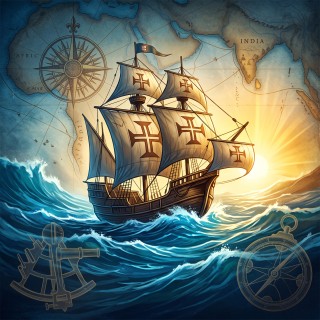
What fueled this audacious endeavor? The answer lies in a confluence of factors. Geographically, Portugal’s Atlantic coastline provided a natural launching pad for overseas voyages. Politically, the consolidation of its monarchy allowed for the centralization of resources and strategic direction. Economically, the lure of lucrative spice routes to the East, bypasssing the Venetian and Ottoman intermediaries, was a powerful motivator. But perhaps most crucial was the intellectual and technological revolution occurring within Portugal itself. Prince Henry the Navigator, though never a mariner himself, was a visionary patron of exploration. He established a school of navigation in Sagres, bringing together cartographers, astronomers, and shipbuilders. Under his guidance, innovations like the caravel – a light, fast, and highly maneuverable ship capable of sailing against the wind – transformed maritime travel. Astrolabes and quadrants became essential tools, allowing sailors to determine their latitude with unprecedented accuracy.
The initial Portuguese forays were down the coast of West Africa. These voyages, starting with the capture of Ceuta in North Africa, were not just about discovery; they were about establishing trading posts, seeking gold, slaves, and new agricultural lands. The strategic island chains of Madeira, the Azores, and Cape Verde became vital stepping stones, providing resupply points and bases for further exploration. As the Portuguese pushed further south, they encountered diverse cultures and vast, untapped resources, fueling their imperial ambitions.
Bartolomeu Dias’s monumental rounding of the Cape of Good Hope in 1488 shattered the long-held belief that Africa was an impassable barrier to the East. This triumph opened the sea route to India, a route that Vasco da Gama would famously complete in 1498. Da Gama’s arrival in Calicut marked a pivotal moment. It bypassed the traditional land routes controlled by Muslim traders and Venice, effectively breaking their monopoly on the incredibly lucrative spice trade. Spices like pepper, cinnamon, and cloves, once luxuries, were now within reach of European markets, albeit still at a premium.
The Portuguese empire was not built on vast land conquests in the traditional sense, but rather on a network of fortified trading posts and naval dominance. Their strategy, known as ‘Estado da Índia’ (State of India), focused on controlling strategic chokepoints along maritime routes. Goa, Malacca, and Hormuz became critical nodes in this vast network, allowing Portugal to dictate terms of trade and project power across the Indian Ocean. The introduction of cannons on their caravels gave them a decisive military advantage over local fleets, cementing their control.
However, the Portuguese empire was not without its challenges. The vast distances involved made administration difficult and expensive. Competition from other European powers, particularly the Dutch and English, grew fiercer over time. The strain on Portugal’s relatively small population to man ships and administer distant territories was immense. Despite these hurdles, for over a century, Portugal stood as the undisputed master of the seas, a testament to its pioneering spirit and strategic foresight.
What enduring legacy did this early global empire leave? Firstly, it undeniably catalyzed the age of global exchange, intertwining economies and cultures across continents. It initiated the first truly globalized trade network, laying the foundation for modern international commerce. Secondly, it fostered the development of sophisticated navigational and cartographic techniques that would benefit all subsequent maritime powers. Thirdly, it indelibly shaped the demographics and cultures of regions like Brazil, which became a vast Portuguese colony, and parts of Africa and Asia, where Portuguese influence can still be seen in language, religion, and architecture. Portugal’s bold ventures into the unknown not only reshaped its own destiny but profoundly altered the fabric of the entire world, ushering in an era of global interconnectedness that continues to define our present.