S01:E34
Sands of Sovereignty: The High-Stakes Battle for Western Sahara and the Polisario Front
Beneath the blinding glare of the North African sun lies a land of sweeping sand dunes, jagged plateau formations, and a turbulent modern history. Western Sahara, a vast strip of territory bordering Morocco, Algeria, Mauritania, and the Atlantic Ocean, remains one of the world’s most enigmatic and contested geopolitical flashpoints. Often described as ‘Africa’s last colony,’ this desert landscape has been locked in a high-stakes struggle for identity, sovereignty, and survival for over half a century. At the heart of this enduring conflict stands the Polisario Front—a liberation movement turned government-in-exile that has spent decades defying impossible odds.
The origins of the struggle trace back to the late 19th century, when Spain claimed the region as Spanish Sahara. For decades, the nomadic Sahrawi population roamed the harsh terrain, bound by shared tribal heritage and a distinct Hasaniya Arabic dialect. However, as the wave of decolonization swept across Africa in the mid-20th century, a fierce anti-colonial movement took root. In 1973, young Sahrawi nationalists, led by the charismatic student El-Ouali Mustapha Sayed, founded the Frente Polisario (Popular Front for the Liberation of Saguia el-Hamra and Río de Oro). Armed with a fiery desire for self-determination, the Polisario launched a guerrilla campaign against Spanish colonial forces.
Yet, the real storm erupted in 1975. As an ailing dictator, Francisco Franco, prepared for death in Madrid, Spain abandoned its colonial possession without conducting a promised independence referendum. Sensing a historical opportunity, King Hassan II of Morocco staged the dramatic ‘Green March,’ sending over 350,000 unarmed civilians, brandishing Moroccan flags and copies of the Quran, across the border into Western Sahara to claim the land. Simultaneously, Moroccan military forces moved in, while Mauritania annexed the southern sector.
Faced with a dual invasion, tens of thousands of Sahrawis fled into the harsh, barren desert of western Algeria. In the remote region of Tindouf, they established refugee camps—temporary sanctuaries that would tragically evolve into permanent settlements. On February 27, 1976, the Polisario proclaimed the establishment of the Sahrawi Arab Democratic Republic (SADR). What followed was fifteen years of brutal desert warfare. Polisario fighters, highly mobile and intimately familiar with the desert terrain, conducted daring hit-and-run attacks against Moroccan and Mauritanian troops. Mauritania, economically exhausted, withdrew from the conflict in 1979, but Morocco doubled down.
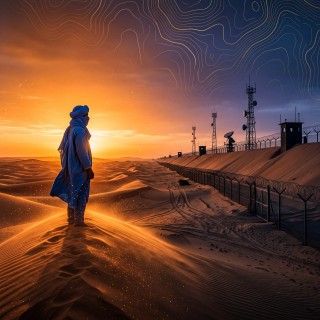
To neutralize Polisario’s guerrilla tactics, Morocco executed an audacious engineering feat: the construction of ‘The Berm.’ Built in stages throughout the 1980s, this massive sand and stone wall stretches over 2,700 kilometers—nearly sixteen hundred miles—across the desert. Outfitted with millions of landmines, sophisticated radar systems, artillery posts, and thousands of troops, the Berm partitioned the territory into two starkly unequal zones. Morocco controlled the western 80 percent, rich in economic assets, while Polisario was left with a narrow, barren strip along the eastern border, known as the ‘Free Zone.’
Beyond political pride, Western Sahara is a land of rich prizes. Deep within its sands lies the Bou Craa mine, home to some of the world’s largest high-grade phosphate reserves, essential for global agricultural fertilizers. Off its coast lie ocean waters teeming with rich marine life, making it a prime Atlantic fishing ground. For decades, foreign corporate interests and legal battles have swirled around the extraction of these natural resources, raising intense ethical questions about international law and resource exploitation in disputed territories.
In 1991, the United Nations brokered a ceasefire between Morocco and Polisario, establishing the peace-keeping mission MINURSO (United Nations Mission for the Referendum in Western Sahara). The core mandate was simple: organize a democratic referendum allowing the Sahrawi people to choose between full independence or integration with Morocco. However, decades slipped by in diplomatic gridlock. Arguments over voter eligibility and political posturing repeatedly scuttled the promised vote.
The fragile peace abruptly shattered in November 2020. Tensions flared in the Guerguerat buffer zone near the Mauritanian border when Moroccan forces cleared a road blocked by Sahrawi protesters. Declaring the 1991 truce broken, Polisario resumed military operations. Shortly thereafter, the geopolitical landscape shifted dramatically when the United States officially recognized Moroccan sovereignty over Western Sahara in late 2020 in exchange for Morocco normalizing diplomatic relations with Israel.
Today, Western Sahara remains a volatile powder keg. Inside the scorching Tindouf refugee camps, a third generation of Sahrawis grows up under political limbo, divided from their ancestral homeland by a heavily fortified sand wall. As regional rivalries between Morocco and Algeria intensify, Western Sahara stands as a compelling testament to the unfinished business of global history—a dramatic saga where ancient sands continue to swallow unbroken dreams of freedom.