S01:E127
Seychelles: Battlefield of the Indian Ocean – Corsairs, Pirate Treasures, and the Surrender of Mahé (1794)
The name “Seychelles” conjures images of an idyllic paradise: pristine white-sand beaches, crystal-clear turquoise waters, and lush, verdant hills dotted with unique granite formations. It’s a dream destination, a sanctuary of peace and natural beauty. Yet, beneath this tranquil veneer lies a tumultuous history, one shaped by daring corsairs, elusive pirate treasures, and fierce imperial rivalries. Far from being a mere collection of remote islands, the Seychelles, and particularly its largest island Mahé, was once a crucial strategic pawn, a contested battlefield in the high-stakes game for dominance over the Indian Ocean. Its story is a thrilling saga of ambition, conflict, and a pivotal capitulation in 1794 that forever altered its destiny.
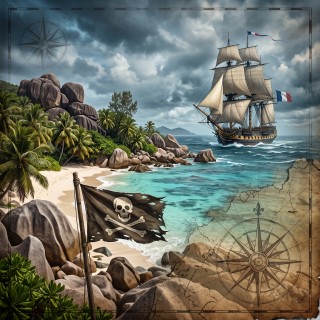
For centuries, the vast expanse of the Indian Ocean was a highway of trade and a crucible of conflict. Lying strategically off the coast of East Africa, the Seychelles archipelago offered an irresistible allure and immense practical value. Its scattered islands provided secluded coves for shelter, abundant fresh water, and timber for repairs – vital commodities for ships undertaking the perilous voyages between Europe, Africa, and the lucrative markets of India and the Far East. Before formalized colonial claims, these attributes made the islands a notorious haven for some of history’s most feared outlaws. Legends abound of pirates like Olivier Levasseur, famously known as La Buse, who allegedly buried an immense treasure somewhere among the granite boulders of Mahé or Silhouette, a prize still sought by intrepid adventurers today. These early visitors, whether plundering buccaneers or desperate mariners, were the first to recognize the islands’ profound strategic potential.
It was the French who first formally laid claim to the islands in the mid-18th century, naming them “La Bourdonnais” in honour of Bertrand-François Mahé de La Bourdonnais, the innovative French Governor of Isle de France (Mauritius). Later renamed “Seychelles” after Jean Moreau de Séchelles, the French Minister of Finance, the archipelago was seen as a vital extension of French influence in the Indian Ocean. Settlements were established on Mahé, transforming it from a mere waypoint into a burgeoning colonial outpost. French planters, many relocating from Mauritius and Réunion, introduced spices, cotton, and slaves, building a small but economically significant society. Mahé, with its sheltered harbour, quickly became a crucial resupply station and a potential base for naval operations, especially as rivalries with the British East India Company intensified.
The late 18th century plunged Europe into the maelstrom of the French Revolutionary Wars, a conflict that swiftly reverberated across the globe. In the Indian Ocean, this meant an escalation of naval skirmishes and a proliferation of “corsairs.” Unlike traditional pirates who operated solely for personal gain, corsairs were privateers, essentially state-sanctioned mercenaries operating under “letters of marque” from their governments. French corsairs, often based in Mauritius, became a constant scourge on British shipping lanes, preying on vessels laden with valuable goods from India. Mahé, with its convenient location and French allegiance, became a crucial ancillary port for these daring raiders, offering refuge and intelligence. The British, desperate to protect their burgeoning trade empire and sever French lines of communication, viewed any French possession in the Indian Ocean as a direct threat.
By 1794, the British determination to neutralize French power in the region reached a boiling point. The British East India Company, effectively a private army and navy in its own right, deployed formidable naval forces. Commodore Henry Newcome, commanding the powerful 74-gun HMS Orpheus, was dispatched to Mahé with a clear objective: secure the island and eliminate its utility to French privateers. The situation on Mahé itself was precarious. The French settlement was relatively small, defended by a modest garrison, largely comprising colonial militia and a few regulars. The French commissaire, Jean-Baptiste Quéau de Quinssy, a shrewd and pragmatic administrator, understood the odds were overwhelmingly against him.
On May 16, 1794, Newcome’s squadron appeared off the coast of Mahé, a formidable display of British naval might. Faced with such overwhelming force, Quinssy had a difficult choice: mount a futile, bloody defense that would inevitably lead to the destruction of the settlement and its inhabitants, or negotiate. Ever the pragmatist, Quinssy chose the latter. He quickly initiated parley with Newcome, engaging in a remarkable act of diplomatic maneuvering that would spare Mahé from devastation. The resulting “capitulation” was a masterstroke of bloodless conquest and shrewd compromise.
Under the terms of the agreement, Quinssy formally surrendered the Seychelles to the British. However, he secured extraordinarily favorable conditions for the French colonists. The islands were declared neutral territory, and critically, French property and the institution of slavery were to be protected. The British, in turn, were granted the right to use the harbour for water and provisions but pledged not to interfere with the local administration or the lives of the inhabitants. This pragmatic agreement meant that while the British gained strategic control, the daily lives of the colonists largely continued uninterrupted. Quinssy’s priority was not to win a military victory he knew was impossible, but to preserve his community and its economic structure.
The capitulation of Mahé in 1794 marked a significant turning point. It was the first instance of British authority being formally asserted over the Seychelles, even if it was a conditional, temporary arrangement. It effectively neutralized the islands as a French base, disrupting the corsair operations and further solidifying British naval supremacy in the Indian Ocean. While the islands would technically revert to French control for periods during subsequent lulls in hostilities, the precedent had been set. The Treaty of Paris in 1814, following Napoleon’s defeat, formally ceded the Seychelles, along with Mauritius, to Great Britain, cementing the fate that had been foreshadowed two decades earlier.
From a pirate’s paradise and a corsair’s haven to a fiercely contested colonial prize, the Seychelles’ history is a vibrant tapestry woven with threads of adventure, conflict, and diplomatic intrigue. The tranquil beauty that draws visitors today belies a past where powerful empires clashed, and brave individuals, whether pirates, privateers, or colonial administrators, carved out their destinies against the backdrop of an unforgiving ocean. The capitulation of Mahé in 1794 stands as a testament to this complex legacy, a moment when the destiny of a tropical paradise was decided not by cannon fire, but by a strategic handshake, forever branding the Seychelles as a true battlefield of the Indian Ocean.