No transcript available for this episode.
S01:E22
Shadows in the Jungle: The Brutal Reality of the Vietnam War
The air in the Vietnamese jungle is thick, heavy with humidity and the ominous silence of impending chaos. It is the mid-20th century, and a small Southeast Asian nation is about to become the explosive epicenter of a global ideological clash. The Vietnam War was not just a localized civil conflict; it was a fiery proxy battlefield of the Cold War, pitting the capitalist West against the communist East in a struggle that would redefine warfare, media, and politics forever.
Following the end of French colonial rule in 1954 after the brutal battle of Dien Bien Phu, Vietnam was sliced in two at the 17th parallel. The North, led by the charismatic and iron-willed communist revolutionary Ho Chi Minh, sought to reunify the country under a single communist banner. The South, backed by the United States, resisted under a series of unstable, autocratic regimes. What began as a low-level insurgency by communist guerillas in the South—collectively known as the Viet Cong—soon spiraled into an inescapable vortex of global violence.
By 1964, the United States, driven by the ‘Domino Theory’—the geopolitical fear that if one nation fell to communism, its neighbors would inevitably fall like a row of dominos—stepped directly into the crucible. Following the highly controversial and disputed Gulf of Tonkin incident, President Lyndon B. Johnson received a virtual blank check from Congress to wage military campaigns. Soon, hundreds of thousands of young American GIs, many drafted straight out of high school, were shipped off to a rugged, foreign land they barely understood.
But this was no conventional war. There were no clear front lines to capture, no massive armies clashing in open European-style fields. Instead, it was a war of shadows, stealth, and survival. The Viet Cong utilized devastating guerrilla tactics, transforming the natural environment into a lethal weapon. They melted effortlessly into the dense, triple-canopy jungles and constructed thousands of miles of complex, multi-tiered underground tunnel networks, such as the famous Củ Chi tunnels. These subterranean fortresses contained barracks, hospitals, and command centers, allowing the insurgents to vanish in an instant. Furthermore, they rigged the terrain with horrific, low-tech booby traps. Punji sticks smeared with animal waste, tripwires connected to rusty grenades, and hidden trapdoors turned every single step of a patrol into a potentially fatal nightmare.
To combat an invisible enemy, the United States military relied on overwhelming technological superiority and massive firepower. They unleashed ‘Operation Rolling Thunder,’ a multi-year, relentless bombing campaign that dropped more ordnance on Vietnam than was used in all of World War II. They also deployed devastating chemical agents. ‘Agent Orange,’ a powerful toxic defoliant, was sprayed from airplanes to strip away the dense jungle foliage and expose the hidden enemy, while ‘Napalm’—a highly flammable, jelly-like gasoline—was dropped to incinerate wide swaths of land. Yet, despite this sheer destructive power, the supply lines of the North, winding secretly through neighboring Laos and Cambodia along the intricate Ho Chi Minh Trail, remained stubbornly functional, constantly repaired under the cover of night by thousands of dedicated workers.
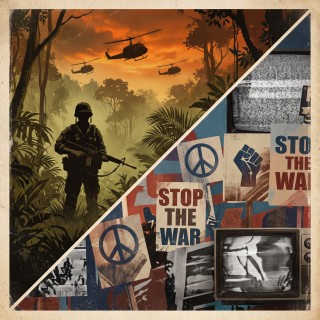
The ultimate turning point came in late January 1968, during the sacred Vietnamese New Year holiday known as Tet. In a massive, highly coordinated surprise attack, over 80,000 communist troops struck more than 100 cities, towns, and military bases across South Vietnam simultaneously. Even the heavily fortified US Embassy in Saigon was breached. While the Tet Offensive was ultimately a catastrophic military defeat for the communists, who suffered massive casualties, it was a decisive psychological and political victory. Back in the United States, millions of citizens watched the raw, shocking reality of the fighting on their television screens. The US government’s confident assurances that the war was being won evaporated overnight, giving way to a profound ‘credibility gap.’
As the body bags returned home and the costs soared, a powerful, unprecedented anti-war movement swept across America and the globe. Universities erupted in fierce protests, draft cards were burned in defiance, and citizens from all walks of life questioned the morality of the conflict. Realizing the war had become politically unsustainable, President Richard Nixon initiated ‘Vietnamization’—a strategy aimed at gradually withdrawing American troops while training and equipping South Vietnamese forces to assume the burden of their own defense.
By 1973, the Paris Peace Accords were signed, leading to the departure of the last American combat troops. However, the fragile peace did not last. In the spring of 1975, the North Vietnamese Army launched a final, overwhelming offensive. The world watched in sheer disbelief as helicopters frantically evacuated desperate crowds from the rooftops of Saigon. On April 30, 1975, communist tanks crashed through the gates of the Presidential Palace. Saigon had fallen, and Vietnam was officially reunified. The war was finally over, leaving behind a scarred land, millions of dead Vietnamese, over 58,000 fallen American soldiers, and a legacy of trauma that would echo through generations.