0:00Intro
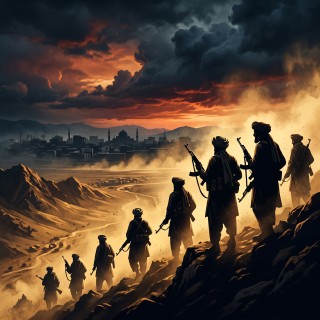
Shadows Over Kandahar: The Meteoric Rise of the Taliban (1994–1996)
In the autumn of 1994, Afghanistan was a broken nation bleeding from a thousand wounds. The Soviet-Afghan War had ended five years earlier, leaving behind a scarred countryside, but the defeat of the superpower brought no peace. Instead, the country disintegrated into a brutal, multi-sided civil war. Mujahideen commanders—once lauded as holy warriors fighting the Soviet empire—had transformed into ruthless warlords. Kabul was carved into hostile fiefdoms, devastated by relentless rocket fire from competing factions. Across the countryside, local commanders set up illegal checkpoints along vital trade routes, extorting, robbing, and terrorizing civilians with total impunity. Lawlessness reigned, and the Afghan population was utterly desperate for order and safety.
It was in this chaotic vacuum that a quiet religious cleric named Mullah Mohammad Omar made his move. A veteran Mujahideen fighter who had lost his right eye fighting against the Soviets, Mullah Omar was teaching in a madrasa in the rural village of Singesar, near Kandahar. Dismayed by the rampant corruption, extortion, and moral decay around him, he gathered a small group of Islamic religious students—known in Pashto as “Taliban.” Myth and history blend around their first public action: legend holds that Mullah Omar and roughly thirty followers, armed with just a few rifles, rescued two young girls who had been abducted by a local warlord, hanging the corrupt commander from a tank barrel. Whether factual or exaggerated, the story captured the imagination of a deeply conservative and exhausted public.
The Taliban’s core message was deceptively simple: disarm the warlords, restore peace and security, and strictly enforce Islamic law. In a land shattered by endless conflict, basic security was a priceless currency. As the group marched toward Kandahar in late 1994, local populations often welcomed them without firing a single shot. Corrupt warlords fled or defected, intimidated by the zealous unity and discipline of the religious students. By November 1994, Kandahar—Afghanistan’s second-largest city and the historic heartland of the Pashtuns—fell to the Taliban with surprisingly little resistance. Overnight, thousands of defectors, local fighters, and religious students flooded their ranks.
This meteoric rise did not go unnoticed across the border. Neighboring Pakistan, particularly its powerful Inter-Services Intelligence (ISI) agency and the government of Prime Minister Benazir Bhutto, saw an unprecedented geopolitical opportunity. Pakistan desperately wanted a stable trade corridor through Afghanistan into the newly independent, resource-rich states of Central Asia. Frustrated by the unpredictable and warring Mujahideen factions in Kabul, Islamabad threw its immense political, financial, and logistical support behind the Taliban. Flowing from Pakistani madrasas, tens of thousands of young Pashtun recruits—many raised in impoverished refugee camps—crossed the border to reinforce Mullah Omar’s growing army.
With captured military hardware, including heavy artillery, tanks, and even Soviet-made fighter jets, the Taliban rapidly evolved from a ragtag vigilante group into a formidable, conventional military force. In September 1995, they swept west and captured the ancient, culturally rich city of Herat, forcing the legendary warlord Ismail Khan to flee into Iran. The fall of Herat stunned international observers and demonstrated that the Taliban were no longer a mere regional phenomenon; they were contending for total control of the nation.
By early 1996, the Taliban had laid siege to Kabul itself. Standing in their way was the brilliant military commander Ahmad Shah Massoud, the “Lion of Panjshir,” who served as Defense Minister under the fragile government of Burhanuddin Rabbani. Massoud’s forces mounted a fierce resistance, inflicting heavy casualties on the Taliban around the capital. However, encircled and facing continuous pressure from multiple fronts, Massoud recognized that a prolonged fight inside Kabul would lead to the total destruction of the city and massive civilian casualties. On September 26, 1996, Massoud executed a disciplined tactical retreat, withdrawing his forces north into the safety of the Panjshir Valley.
On September 27, 1996, the Taliban marched triumphantly into Kabul. Their entry was marked by a shocking act of violence that portended the dark era to come. They stormed the United Nations compound where Afghanistan’s former communist president, Mohammad Najibullah, had sought sanctuary since 1992. Najibullah was brutally tortured, killed, and his bloodied body was publicly hanged from a traffic light post in the city center.
With Kabul under their firm control, the Taliban declared the establishment of the Islamic Emirate of Afghanistan, imposing their uncompromising, radical interpretation of Sharia law over the nation. In just two short years, from an obscure village near Kandahar to the presidential palace in Kabul, the Taliban had executed one of the most rapid and dramatic political ascents in modern history—setting the stage for events that would reshape global politics for decades to come.