No transcript available for this episode.
S01:E38
Shadows over the Caucasus: The Gritty Story of the Chechen Conflicts
High up in the towering, snow-capped peaks of the North Caucasus mountains, a storm had been brewing for centuries. But when the Soviet Union collapsed in late 1991, the political dam broke entirely. Out of the ashes of the fallen superpower, a small, fiercely proud enclave declared its independence: Chechnya. Led by Dzhokhar Dudayev, a charismatic former Soviet Air Force general, the newly proclaimed Chechen Republic of Ichkeria sought to sever ties with Moscow once and for all. Moscow, however, viewed Chechnya not merely as a breakaway province, but as a critical strategic corridor rich in oil pipelines and vital to the stability of the entire region. The stage was set for one of the most brutal and harrowing geopolitical sagas of the late 20th and early 21st centuries.
In December 1994, Russian President Boris Yeltsin dispatched columns of armored vehicles and thousands of troops into Chechnya, expecting a quick, decisive operation to restore order. What the military command anticipated would take days turned into an agonizing nightmare. When Russian armor rolled into the Chechen capital of Grozny on New Year’s Eve in 1994, they entered an urban kill zone. Chechen fighters, intimately familiar with the city’s complex layout and expert in guerrilla warfare, ambushed armored columns with anti-tank rockets from shattered high-rise buildings. Grozny quickly became a graveyard of burning steel and broken illusions.
Despite overwhelming Russian air superiority and heavy artillery, the resilience of the Chechen forces ground the campaign to a bloody standstill. Horrific civilian casualties and fierce resistance dominated global headlines. By 1996, humiliated by tactical setbacks and facing mounting public outrage at home, Russia agreed to a ceasefire. The 1996 Khasavyurt Accord brought a fragile peace, leading to the complete withdrawal of Russian troops and leaving Chechnya in a state of de facto independence, though its ultimate legal status was deferred.
Yet, peace proved hauntingly elusive. Post-war Chechnya rapidly descended into economic devastation, lawlessness, and political chaos. Local warlords, criminal syndicates, and armed factions operated with absolute impunity, turning the republic into a haven for kidnapping and illegal trade. Simultaneously, the nature of the Chechen movement underwent a radical shift. What had begun as a secular struggle for national self-determination was increasingly hijacked by radical pan-Islamic extremists and foreign jihadist fighters. Key leaders like Shamil Basayev and the Saudi-born warlord Khattab championed an uncompromising Wahhabi agenda, alienating moderate Chechen nationalists.
The fragile quiet shattered in August 1999, when Basayev led an armed insurgency into the neighboring Russian republic of Dagestan, attempting to establish an Islamic state. Weeks later, a series of catastrophic apartment building bombings tore through several Russian cities, including Moscow, killing nearly 300 innocent civilians. Though Chechen officials denied responsibility, the Russian public demanded decisive action and retribution.
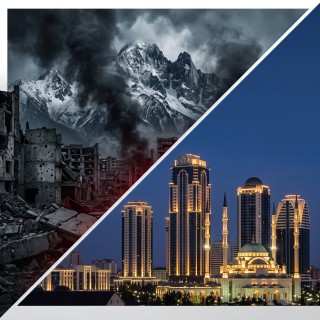
Russia’s newly appointed Prime Minister, Vladimir Putin, seized the moment, launching a relentless second campaign defined by overwhelming military force. The Second Chechen War began in late 1999 with a massive, systematic bombardment of Grozny. By 2003, the United Nations designated Grozny ‘the most destroyed city on Earth.’ Russian forces painstakingly reasserted control over major urban centers, forcing the remaining insurgent fighters deep into the inaccessible southern mountain ranges.
To secure long-term control without sustaining indefinite military casualties, Moscow implemented a clever and controversial strategy known as ‘Chechenization.’ Instead of relying solely on an occupying army, Russia transferred authority to loyal local factions. Moscow formed an alliance with Akhmad Kadyrov, a former Chief Mufti and rebel commander who had broken with the radical Islamist factions. After Akhmad Kadyrov was assassinated in a 2004 bombing, his ruthless and energetic son, Ramzan Kadyrov, took the reins of power.
As conventional combat waned, the insurgent movement splintered into desperate, high-profile acts of terror. Horrific events such as the 2002 Moscow theater hostage crisis and the tragic 2004 Beslan school siege—where over 300 hostages, mostly children, died—shocked the world and alienated global sympathy for the Chechen cause, framing the conflict through the lens of international anti-terrorism.
By 2009, Russia officially ended its counter-terrorism operation in the region. Today, Grozny is unrecognizable compared to the ruinous landscape of the early 2000s. Glitzy modern skyscrapers, grand mosques, and pristine avenues stand where artillery once rained down. Yet behind this glittering facade lies a tightly controlled autocratic regime. Ramzan Kadyrov rules Chechnya with absolute authority, backed by his feared private security forces, the Kadyrovtsy, and massive financial subsidies from Moscow. The Chechen Conflict remains a dramatic, harrowing chapter of modern history—a stark reminder of the devastating collision between national identity, state power, and radical ideology.