No transcript available for this episode.
S01:E16
Shadows over the Sun: The Year Without a Summer
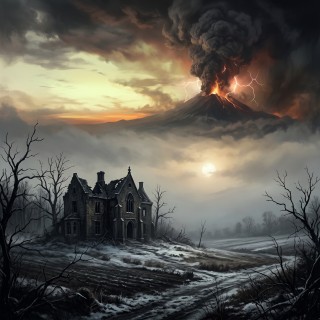
In the spring of 1815, deep within the Dutch East Indies, a monster awoke. Mount Tambora, a colossal volcano on the island of Sumbawa, unleashed the most powerful volcanic eruption in recorded human history. The cataclysmic blast blew the mountain’s peak into the atmosphere, throwing out an estimated 150 cubic kilometers of ash, rock, and toxic gas. The sound of the explosion was heard over 2,600 kilometers away, and the immediate vicinity was plunged into pitch-black darkness for days. Yet, the true horror of Tambora was not its immediate, localized destruction. It was the invisible, slow-moving killer that the volcano released into the sky—a colossal cloud of sulfur dioxide that drifted into the stratosphere, wrapping the Earth in a reflective shroud of aerosol particles. This global dust veil acted as a massive planetary parasol, bouncing the sun’s warmth back into deep space. The world had no idea that a volcanic eruption in the southern hemisphere had just rewritten the climate of the entire globe.
By the time 1816 arrived, the northern hemisphere was plunged into a nightmare that historians would later call “The Year Without a Summer,” or “Eighteen Hundred and Froze to Death.” In North America and Europe, the spring did not bring warmth, but a terrifying continuation of winter. In New England, heavy snow fell in the first week of June. Drifts reached up to a foot deep, and birds froze mid-flight, dropping dead from the sky. Farmers who had already planted their crops watched in horror as severe frosts repeatedly destroyed their seedlings in July and August. The weather behaved like a chaotic beast; one day would bring sweltering summer heat, only for temperatures to plummet below freezing within hours. The sun, when visible at all, appeared as a dim, pale disc, choked out by a bizarre, persistent dry fog that no rain could disperse.
Across the Atlantic, Europe suffered an even grimmer fate. Still reeling from the devastation of the Napoleonic Wars, the continent was entirely unprepared for a total agricultural collapse. The rain was relentless, transforming fertile fields into muddy swamps where potatoes and wheat rotted in the ground. In Switzerland, Ireland, and Germany, the harvest failed completely. Famine gripped the population, bringing with it the inevitable companion of starvation: disease. A devastating typhus epidemic swept through Europe, thriving in the damp, crowded, and unsanitary conditions of desperate populations on the move. Food riots erupted in major cities. Bakeries were looted, grain carts were attacked under armed guard, and thousands of beggars lined the muddy roads, pleading for a crust of bread. It was the worst famine of the 19th century, a humanitarian disaster of global proportions.
Yet, out of this atmospheric apocalypse arose an extraordinary wave of human creativity and technological innovation. In the summer of 1816, a group of young, brilliant English writers—including Mary Godwin (later Mary Shelley), her lover Percy Bysshe Shelley, Lord Byron, and his physician John Polidori—gathered at the Villa Diodati near Lake Geneva in Switzerland. Expecting a sun-drenched holiday, they instead found themselves trapped indoors by endless, gloomy storms and howling winds. To pass the time, Lord Byron proposed a contest: each of them must write a ghost story. Inspired by the dark, electric storms and the apocalyptic atmosphere outside, eighteen-year-old Mary Shelley conceived the tale of “Frankenstein; or, The Modern Prometheus”—a masterpiece born directly from the dark womb of that endless winter. Simultaneously, Polidori penned “The Vampyre,” laying the foundation for modern vampire literature.
Meanwhile, in Germany, the crisis sparked a revolution in transport. With horses starving and being slaughtered for food due to the extreme shortage of oats, a brilliant inventor named Karl Drais sought a mechanical alternative to animal labor. In response to the crisis, he designed the “Laufmaschine” (running machine), a two-wheeled wooden vehicle propelled by the rider’s feet. This revolutionary invention was the direct ancestor of the modern bicycle.
The Year Without a Summer remains a chilling reminder of humanity’s vulnerability to the whims of our planet. It showed how a geological event half a world away could collapse empires, trigger mass migrations, spark scientific breakthroughs, and inspire some of the greatest gothic horrors ever written. It proved that we are all, ultimately, at the mercy of the sky.