S01:E05
Storming the Gates of Power: The Wild Story of the French Revolution
Imagine living in a country where your entire life is decided the moment you are born. If you are born a peasant, you work from sunrise to sunset, pay massive taxes, and often go to bed hungry. If you are born a noble, you live in a glittering palace, wear fine silk, throw lavish parties, and pay absolutely zero taxes. Sounds incredibly unfair, right? Welcome to France in the late 1700s. It was a pressure cooker of anger and hunger waiting to explode. This is the story of the French Revolution—one of the most chaotic, violent, and world-changing events in human history!
To understand why France exploded, we have to look at how society was set up. It was split into three strict groups called ‘Estates.’ The First Estate was the Clergy (church leaders). The Second Estate was the Nobility (rich lords and ladies). Together, they made up only 2% of the population but owned most of the land and paid no taxes. The Third Estate was everyone else—a whopping 98% of the people! This included poor farmers, city workers, doctors, lawyers, and shopkeepers. They carried the entire country on their backs, paying all the taxes while having zero say in how France was run.
To make matters worse, France was broke. King Louis XVI and his famous queen, Marie Antoinette, loved spending money on wars, jewelry, and their mega-mansion, the Palace of Versailles. At the same time, a terrible winter destroyed crops, making the price of bread—the main food for most French people—skyrocket. People were literally starving in the streets of Paris while the royals feasted on cake and fine meats.
Desperate for money, King Louis XVI called a meeting of the Estates-General in 1789, a giant parliament that had not met in 175 years. The Third Estate hoped this was their chance for fairness. But the voting system was rigged. Each Estate got only one collective vote. So, the First and Second Estates would always team up to outvote the Third Estate 2-to-1. Furious, the representatives of the Third Estate broke away, met on a nearby indoor tennis court, and swore a famous promise: the ‘Tennis Court Oath.’ They promised not to leave until they had written a new, fair constitution for France.
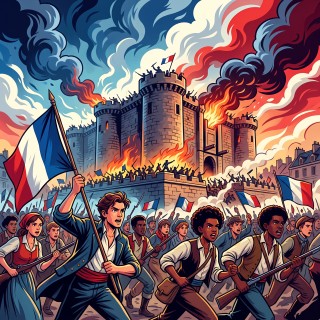
Things escalated fast. On July 14, 1789, an angry mob in Paris decided they needed weapons to protect themselves against the King’s army. They marched to the Bastille, a giant medieval stone fortress and prison that symbolized the King’s absolute power. With axes and muskets, the crowd stormed the prison, fought the guards, and tore the massive stone walls down, brick by brick, with their bare hands. The French Revolution had officially begun! Today, July 14th is celebrated as Bastille Day, France’s national holiday.
At first, the revolution was about making things fair. The new government wrote the ‘Declaration of the Rights of Man,’ declaring that all men are born free and equal. Their slogan was ‘Liberté, Égalité, Fraternité’ (Liberty, Equality, Brotherhood). They wanted a constitutional monarchy where the King had to share power. But things soon spun out of control.
Neighboring countries like Austria and Prussia were terrified that this revolutionary fever would spread to their own people, so they declared war on France. Inside France, fear and paranoia grew. Extremists took control of the government, led by a man named Maximilien Robespierre. They decided that to save the revolution, they had to destroy anyone who opposed it.
This dark period became known as the ‘Reign of Terror’ (1793–1794). A new invention, the guillotine—a heavy, angled blade that dropped down a wooden frame—became the symbol of this era. King Louis XVI and Marie Antoinette were accused of treason and executed by the guillotine. Anyone suspected of not being enthusiastic enough about the revolution could be arrested and beheaded. Over 17,000 people were officially executed during this terrifying time.
Eventually, the people grew tired of the endless bloodshed. Robespierre himself was arrested and sent to the guillotine, ending the Terror. The chaos left France unstable until a brilliant and ambitious young military general named Napoleon Bonaparte stepped in, eventually seizing power and crowning himself Emperor.
The French Revolution was a wild, bloody rollercoaster, but it changed the world forever. It proved that ordinary people could stand up against absolute rulers, demand their human rights, and completely reshape society. The modern ideas of democracy, human rights, and equality that we take for granted today were forged in the fiery streets of Paris over two hundred years ago.