S01:E110
The 45-Minute Fury: Unraveling the Anglo-Zanzibar War of 1896
Imagine a conflict that begins and ends before your morning coffee cools, a war so swift it barely registers as a blip on the radar of human brutality. Welcome to the astonishing, almost comical, saga of the Anglo-Zanzibar War of 1896 – officially, and quite spectacularly, the shortest war in recorded human history. Clocking in at a mere 38 to 45 minutes (depending on which startled timepiece you consult), this isn’t just a historical footnote; it’s a testament to colonial power, political maneuvering, and a dramatic display of overwhelming force.
The year is 1896. Zanzibar, a vibrant spice-trading sultanate off the coast of East Africa, is a British protectorate. While nominally independent, its foreign policy and, increasingly, internal affairs were dictated by London. The reigning Sultan, Hamad bin Thuwaini, a British-aligned ruler, had died suddenly on August 25th. His death triggered a pre-existing succession crisis, exacerbated by the colonial powers’ desire for stability and control.
Enter Khalid bin Barghash, the Sultan’s nephew and a determined, albeit rebellious, individual. Without seeking British approval, and in direct defiance of their wishes, Khalid seized the royal palace and declared himself Sultan. His claim was based on a traditional line of succession, but the British, wary of an anti-British ruler and fearing a challenge to their authority, had a different candidate in mind: Hamud bin Mohammed. They saw Khalid as a potential puppet of German interests, further complicating the delicate balance of power in the region.
The British ultimatum was swift and unequivocal: Khalid was to vacate the palace by 9 AM on August 27th, or face the consequences. But Khalid, perhaps underestimating the resolve of the British Empire, or perhaps emboldened by his small, loyal army and a single, albeit outdated, armed yacht, refused. He barricaded himself in the palace, fortified its defenses, and awaited the inevitable.
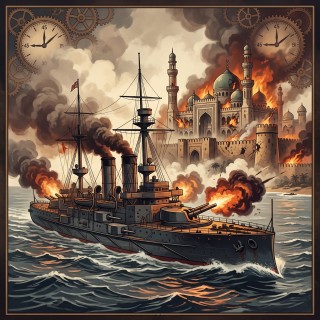
As the clock ticked towards the fateful hour, the British squadron, a formidable array of warships including HMS St George, HMS Philomel, HMS Racoon, HMS Thrush, and HMS Sparrow, positioned itself strategically in Zanzibar Harbour. Their guns were trained on the palace. Rear-Admiral Harry Rawson, leading the British forces, was a man of action, not negotiation. The ultimatum expired. At precisely 9:00 AM, the British opened fire.
The ensuing bombardment was devastatingly effective. The palace, built more for grandeur than defense, quickly crumbled under the relentless shelling. Khalid’s forces, though spirited, were no match for the superior firepower and training of the Royal Navy. The sultanate’s single armed yacht, the Glasgow, was sunk within minutes. Buildings adjacent to the palace caught fire, and the smoke billowed across the harbor, a grim testament to the speed of modern warfare.
Within 38 to 45 minutes, Khalid’s banner was shot down, and the firing ceased. Estimates of casualties vary, but it is believed that around 500 of Khalid’s soldiers and palace inhabitants were killed or wounded, while the British suffered only one casualty – a single petty officer injured in a boat. Khalid himself managed to escape through a back exit, seeking asylum at the German consulate. He was later transported to German East Africa, where he remained for years.
The aftermath was equally swift. Hamud bin Mohammed was installed as the new Sultan, a ruler compliant with British interests. The British cemented their control over Zanzibar, effectively ending any pretense of independent rule. The Anglo-Zanzibar War of 1896 stands as a stark reminder of the might of colonial powers and the dramatic, often brutal, efficiency with which they maintained their dominance. It’s a war that ended before most people had even heard it began, a fleeting yet impactful moment in the annals of history that continues to fascinate and instruct on the dynamics of power and conflict.