No transcript available for this episode.
S01:E65
The Accidental Masterpiece: How an Overdose of Aldehydes Created Chanel No. 5
In the sun-drenched hills of Grasse, France, in late 1920, the air inside Ernest Beaux’s perfume laboratory hung thick with the heady, indolic aromas of May rose and precious jasmine. Perfumery at the dawn of the twentieth century was strictly bifurcated by social class and decorum. Respectable women wore delicate soliflores—fragrances that mimicked a single innocent flower, such as violet, lily of the valley, or lavender. Musks, civet, and heavy animalic notes were reserved almost exclusively for courtesans and demi-mondaines. But Gabrielle ‘Coco’ Chanel wanted none of this antiquated morality. She envisioned something radical: a fragrance that did not smell like a garden, but rather an engineered, abstract composition. She demanded a scent that smelled artificial in the grandest sense of the word—a clean, complex fragrance that smelled like a modern woman.
To realize this vision, Chanel turned to Ernest Beaux, a brilliant French-Russian perfumer who had previously served the Imperial Romanov court. Beaux was an adventurous artist fascinated by recent advances in organic chemistry, specifically synthetic aliphatic aldehydes. These laboratory-synthesized compounds produced sharp, metallic, waxy, and citrusy scents. In minuscule trace amounts, aldehydes were known to brighten and elevate natural floral extracts, much like a pinch of salt enhances the sweetness of chocolate. However, perfumers regarded them with extreme trepidation; even a slight miscalculation could result in a sharp, chemical stench resembling snuffed candles or rancid fat.
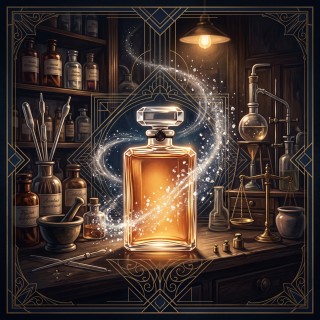
Beaux set to work in his laboratory, developing two series of numbered prototype glass vials: one numbered 1 through 5, and the other numbered 20 through 24. While compounding the formulas, fate intervened in the form of human error. Beaux’s laboratory assistant was preparing the fifth formulation. Fatigued or momentarily distracted, the assistant misread the recipe’s ratio and added an unprecedented, staggering overdose of aldehydes—nearly ten times the intended concentration, reaching an unprecedented one percent of the concentrate. In standard perfumery terms of the era, this was a catastrophic failure that should have ruined the batch completely.
Yet, when Ernest Beaux evaluated the finished vial labeled ‘No. 5’, he did not smell a ruined mixture. Instead, an olfactory miracle had occurred. Rather than overwhelming the delicate Grasse jasmine and rose de Mai, the massive surge of aldehydes acted as a shimmering, hyper-modern diffuser. The chemical explosion unlocked the dense, heavy floral essences, transforming them into a brilliant, sparkling effervescence. It was as if the sun had suddenly broken through heavy morning fog, giving the scent a brisk, frosty crispness reminiscent of winter air over Arctic rivers—a sensory memory Beaux had carried with him from his military service in Murmansk.
When Coco Chanel visited the laboratory to sample the prototypes, she methodically tested each vial. Without hesitation, she pointed directly to the fifth vial. ‘I present my dress collections on the fifth of May, the fifth month of the year,’ Chanel famously declared. ‘So we will let this number five keep the name it already has; it will bring good luck.’
Launched officially in 1921, Chanel No. 5 shattered every established rule of fragrance design. Housed in a stark, minimalist, rectangular bottle that stood in defiance of the ornate, crystal-fluted flacons of the Belle Époque, the perfume captured the spirit of the Jazz Age. The accidental aldehyde overdose gave No. 5 its inimitable, abstract signature—a luminous, champagne-like fizz that floats effortlessly above rich sensual florals and warm woods. What began as a distracted laboratory assistant’s blunder became the ultimate triumph of modern perfumery, permanently redefining luxury and creating the most famous, enduring fragrance in human history.