No transcript available for this episode.
S01:E82
The Accidental Purple Revolution: How a Teenage Chemist Changed the World of Color
Imagine a world devoid of vibrant, lasting colors. A world where clothing faded quickly, dyes were derived from often rare and expensive natural sources, and a limited palette dominated everyday life. This was largely the reality before 1856. Then, a seemingly innocuous experiment in a modest London laboratory, conducted by an 18-year-old prodigy, irrevocably altered the course of fashion, science, and industry, painting the world in a dazzling new light.
Our story begins with William Henry Perkin, a brilliant young chemist working under the esteemed August Wilhelm von Hofmann at the Royal College of Chemistry. Perkin, like many scientists of his era, was captivated by the promise of synthesizing quinine, a crucial anti-malarial drug derived from the bark of the cinchona tree. Malaria was a devastating global scourge, and a synthetic alternative would be a medical triumph of unparalleled proportions. It was during his Easter break in 1856, while conducting experiments in his makeshift home laboratory, that fate intervened.
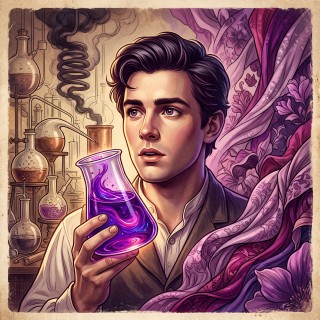
Perkin’s initial attempts to synthesize quinine were, by all accounts, failures. He was working with aniline, a derivative of coal tar, attempting to oxidize it in a specific way to create quinine. Instead, he observed a dark, tarry residue forming in his flask. Most chemists would have discarded this unpromising gunk and moved on. But Perkin possessed an insatiable curiosity and an eye for the unexpected. He noticed that when he cleaned his glassware with alcohol, a rich, vibrant purple stain appeared. This wasn’t just any purple; it was a luminous, almost iridescent shade that seemed to shimmer with an inner light. He called it ‘mauveine,’ or simply ‘mauve,’ after the French word for the mallow flower, which shared a similar delicate purple hue.
This accidental discovery was nothing short of revolutionary. Natural purple dyes, like the Tyrian purple of antiquity, were incredibly expensive and laborious to produce, often reserved for royalty and the highest echelons of society. Perkin’s mauve, by contrast, could be manufactured relatively cheaply and in large quantities. More importantly, it possessed an unprecedented fastness – it wouldn’t fade easily in sunlight or wash out, a significant improvement over many natural dyes.
Perkin, with the encouragement of his mentor Hofmann (who initially dismissed the discovery but quickly recognized its potential), shrewdly patented his invention. This was a bold move for a teenager, demonstrating remarkable foresight. He soon left academia, and with the financial backing of his father and brother, established a dye factory near Greenford Green on the Grand Union Canal. The factory initially struggled, facing skepticism from the textile industry, which was deeply entrenched in natural dyeing methods. But the undeniable beauty and practicality of mauve could not be ignored for long.
The turning point came with Empress Eugénie of France, a renowned fashion icon of the Second Empire. She reportedly wore a mauve gown to a public event, instantly cementing the color’s status as the height of fashion. Suddenly, everyone wanted to wear mauve. From Paris to London, the ‘mauve craze’ swept across Europe and beyond. The previously rare and royal color became accessible to the masses, adorning dresses, ribbons, gloves, and hats. Perkin’s factory boomed, and he became a wealthy man before he was 21.
Perkin’s accidental discovery didn’t just introduce a new color; it ushered in an entirely new industry. His success with mauveine spurred other chemists to experiment with coal tar derivatives, leading to the synthesis of a plethora of other brilliant synthetic dyes – fuchsine, magenta, aniline blue, and many more. The drab world of limited natural colors gave way to an explosion of vibrant hues, transforming the textile industry, art, and everyday life. This marked the birth of the synthetic organic chemical industry, a field that would go on to produce not only dyes but also pharmaceuticals, plastics, and countless other modern marvels.
Perkin’s legacy extends far beyond a single color. He demonstrated the immense potential of applied chemistry, linking pure research to practical industrial applications. His journey from aspiring anti-malarial synthesizer to the ‘father of the synthetic dye industry’ is a testament to the power of observation, curiosity, and the serendipitous nature of scientific discovery. The accidental purple revolution, sparked by an 18-year-old’s ‘failure,’ forever changed how we see and color our world.