No transcript available for this episode.
S01:E32
The Alchemist of the Universe: How Isaac Newton Rewrote Reality
In the summer of 1665, a deadly outbreak of the bubonic plague swept through the crowded streets of London, turning the bustling metropolis into a silent, terrifying graveyard. To escape the rampant infection, Cambridge University closed its doors, sending its students home. Among them was a quiet, socially awkward twenty-two-year-old named Isaac Newton, who returned to his family’s isolated farm at Woolsthorpe Manor in Lincolnshire. The world outside seemed to be grinding to a tragic halt, but inside Newton’s restless mind, an unprecedented cosmic revolution was quietly taking root. The next eighteen months would become known to history as the ‘Annus Mirabilis’—the Year of Wonders. Confined to the solitude of a quiet farmhouse, Newton did not merely bide his time; he completely disassembled humanity’s understanding of the physical world and rebuilt it from scratch.
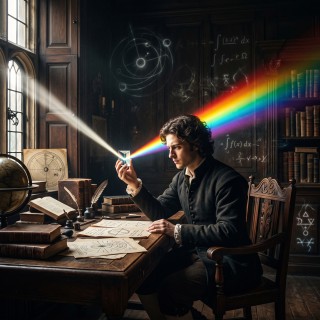
Newton began his intellectual rebellion by probing the deeply hidden secrets of light and vision. At the time, mainstream natural philosophy asserted that color was merely a modification of pure white light, created when light collided with shadow or passed through matter. Unconvinced by traditional dogma, Newton conducted a daring series of optical experiments. He bored a tiny hole through his dark wooden window shutters, admitting a single, needle-thin ray of sunlight into a darkened room. Passing this white beam through a glass triangular prism, he watched in awe as it scattered into a vivid, glowing rainbow across the opposite wall. To prove that the prism was not adding color to the light, he isolated a single color from the spectrum and passed it through a second prism; it remained unchanged. Furthermore, by passing the entire spectrum back through an inverted prism, he successfully recombined the rainbow into pure white light. In that single, breathtaking revelation, Newton shattered centuries of Aristotelian physics, proving that white light was not pure, but a complex compound of every color in the visible spectrum.
Yet light was merely the warm-up act. Newton found himself deeply frustrated by the limitations of seventeenth-century mathematics, which were entirely incapable of calculating changing velocities or curved movements in space. Nature was dynamic—planets accelerated in elliptical orbits, tides shifted, and cannonballs curved under the pull of Earth. To bridge this vast intellectual gap, Newton invented an entirely new branch of mathematics called the ‘method of fluxions,’ which we know today as calculus. With this revolutionary tool, mathematicians could finally calculate instantaneous rates of change, unleashing a mathematical framework that would eventually pave the way for modern engineering, space exploration, and quantum physics.
Legend recounts that while sitting in the quiet orchard at Woolsthorpe, Newton observed an apple drop from a tree branch to the ground. Whether the fruit actually struck his head is debated by historians, but the mental spark it ignited transformed world history forever. Newton asked a fundamental question: why did the apple fall straight toward the center of the Earth rather than floating sideways or upward? He reasoned that the invisible force drawing the apple down must extend far beyond the highest tree branches, reaching across the void of space to pull the Moon into its perpetual curve around the Earth. Gravity was not a local phenomenon; it was universal. In 1687, urged on by astronomer Edmund Halley, Newton published his monumental treatise, ‘Philosophiae Naturalis Principia Mathematica.’ In this work, he articulated the Three Laws of Motion and the Universal Law of Gravitation, unifying the earth and the heavens under one majestic, predictable set of mathematical rules.
Yet, Newton was far from a dry, dispassionate modern scientist. Behind his prestigious public image hid a deeply secretive, obsessive figure who spent long, toxic nights in smoky clandestine laboratories trying to decipher ancient biblical prophecies and searching for the legendary philosopher’s stone through intense alchemical experiments. He actually wrote far more words on esoteric alchemy and divine theology than he ever did on physics or math. In his later years, Newton abandoned academic life at Cambridge to become the Warden of the Royal Mint in London. Far from treating the post as a sleepy honorific, he personally hunted down notorious counterfeiters, chasing them through London’s dangerous criminal underbelly and ensuring their execution at the gallows.
When Isaac Newton passed away in 1727, he was buried with grand royal pomp in Westminster Abbey—the first scientist ever granted such an honor. Driven by intense curiosity, dark paranoia, and fierce scientific rivalries, he dragged human thought out of medieval mysticism and into the brilliant light of the Scientific Revolution. As Newton famously wrote, ‘If I have seen further, it is by standing on the shoulders of giants.’ Yet in truth, Newton himself became the colossal giant upon whose shoulders the modern technological world was built.