S01:E123
The Audacious Heist: How the Mona Lisa Became a Global Icon
August 21, 1911. A seemingly ordinary Monday morning at the Louvre Museum in Paris. The sun, still gently warming the city, cast long shadows through the grand galleries. Tourists and art enthusiasts alike meandered through the hallowed halls, unaware that one of the most audacious art thefts in history was about to unfold, forever changing the destiny of a certain enigmatic smile.
The Mona Lisa, a portrait by Leonardo da Vinci, painted in the early 16th century, was already a revered work. However, it was not yet the universally recognized cultural phenomenon it is today. In fact, before its disappearance, many visitors to the Louvre might have breezed past it, perhaps giving it a cursory glance. Its frame, a rather modest affair, was often overshadowed by the more opulent and larger works surrounding it. Yet, this unassuming painting was about to embark on an involuntary journey that would catapult it to unprecedented global fame.
The man responsible for this seismic event was Vincenzo Peruggia, an Italian handyman who had previously worked at the Louvre, installing protective glass casings for several of the museum’s artworks, including the Mona Lisa. Peruggia was, by all accounts, a quiet and unassuming individual, a patriot consumed by a fervent, if misguided, belief: that Italy’s masterpieces, stolen by Napoleon, rightfully belonged on Italian soil. He saw himself not as a thief, but as a liberator, righting a historical wrong. This profound conviction fueled his extraordinary act.
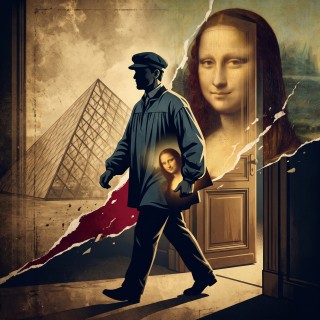
On that fateful Monday, Peruggia, dressed in a white smock identical to those worn by Louvre employees, simply walked into the museum before it opened to the public. He knew the layout, the routines, the blind spots. Approaching the Salon Carré, where the Mona Lisa hung, he found himself momentarily alone. With astonishing calm and efficiency, he lifted the painting from its hooks, carried it to a nearby service staircase, and there, using simple tools, removed the painting from its heavy wooden frame. The frame itself, a cumbersome object, was abandoned on the stairs.
Then came the most astonishing part of the whole affair. Peruggia wrapped the unframed Mona Lisa – a painting on a poplar wood panel, measuring roughly 77 cm by 53 cm – in his smock and, with the masterpiece tucked under his arm, simply walked out of the museum. He passed a guard, who barely registered his presence, assuming he was just another employee. The streets of Paris, bustling with morning activity, offered anonymity. Peruggia boarded a bus and returned to his modest boarding house, where he hid the painting in a false-bottomed trunk. For two long years, the Mona Lisa resided in this unassuming dwelling, a world away from its gilded palace.
It wasn’t until Tuesday morning that the theft was discovered. A painter, Louis Béroud, arrived at the Salon Carré to sketch the Mona Lisa for a series of paintings. To his bewilderment, the space where the masterpiece should have hung was empty. Initially, museum officials assumed the painting had been temporarily removed for photography or conservation. It was a common practice. But as hours turned into a frantic search, the grim reality dawned: the Mona Lisa was gone.
The news sent shockwaves across the globe. Paris was in an uproar. The Louvre was shut down for a week, and every available resource was poured into the investigation. Suspects ranged from famous artists like Pablo Picasso and Guillaume Apollinaire (who were actually questioned and briefly detained due to previous association with other art thefts) to international criminal masterminds. The sheer audacity of the crime captured the public imagination. Newspapers sensationalized the story, publishing countless articles and photographs of the ‘missing’ Mona Lisa. Suddenly, everyone knew her name, her enigmatic smile, her story.
Reward offers poured in, reaching astronomical sums. Postcards, posters, and even songs were created in her honor. The void on the Louvre wall became a morbid attraction, with crowds gathering to stare at the empty space. This period of absence inadvertently became the single greatest publicity campaign the Mona Lisa could ever have wished for. Her image was reproduced endlessly, cementing her status as a global icon.
Peruggia, meanwhile, remained undetected. He kept the painting hidden, occasionally showing it to friends, claiming it was a copy. His plan was to eventually return it to Italy. In December 1913, he contacted an art dealer in Florence, Alfredo Geri, offering to sell the Mona Lisa back to Italy for 500,000 lire, ostensibly for its rightful place in the Uffizi Gallery. Geri, skeptical but intrigued, arranged a meeting with the director of the Uffizi, Giovanni Poggi. After careful authentication – a process that involved comparing the painting to the original frame and noting peculiar details of the poplar wood panel – the art world let out a collective gasp: it was indeed the real Mona Lisa.
Peruggia was arrested, his patriotic motivations acknowledged but not excused. He served a relatively light sentence, only seven months, for his crime, becoming something of a folk hero in Italy. The Mona Lisa, after a brief exhibition tour across Italy, returned to Paris in January 1914, greeted by ecstatic crowds. She was no longer just a beautiful painting; she was a symbol of resilience, a survivor of an extraordinary adventure. The theft, far from diminishing her, had elevated her to an unparalleled status, making her the most famous, and perhaps the most beloved, work of art in the world.