The Bard of Avon: Decoding the Mystery of William Shakespeare
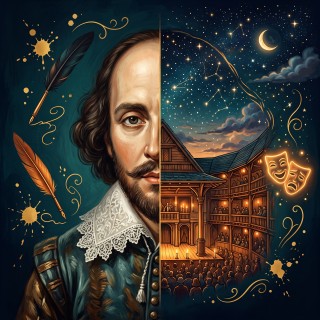
Step into the mud, noise, and sheer raw electricity of late 16th-century London. The air is thick with the smell of roasted meats, Thames river water, and raw sewage. Church bells clash with the shouting of street vendors, the barking of dogs, and the roar of crowds gathered for bear-baiting. But if you cross the river to the south bank, to the disreputable district of Southwark, you will find a different kind of magic. Thousands of people from all walks of life—from dirt-poor laborers to wealthy aristocrats—are pushing their way into a massive, open-air wooden amphitheater: The Globe. They are all here to see the latest masterpiece by London’s ultimate literary shape-shifter, a man whose words would conquer the world, yet whose personal life remains shrouded in deep mystery. Who was William Shakespeare?
Born in the quiet market town of Stratford-upon-Avon in April 1564, William Shakespeare’s beginnings were relatively ordinary. He was the son of John Shakespeare, a successful glovemaker and local politician, and Mary Arden, a woman from a wealthy landowning family. Young William likely attended the local grammar school, where he was drilled in Latin, rhetoric, and classical literature. At age eighteen, he hastily married Anne Hathaway, a woman eight years his senior who was already pregnant. They had three children: Susanna, and twins Hamnet and Judith. And then, the historical trail goes cold.
Between 1585 and 1592, Shakespeare vanishes from all historical records. Biographers call this blank space the ‘Lost Years.’ Did he work as a schoolmaster? Was he a soldier, a lawyer’s clerk, or did he have to flee Warwickshire after being caught poaching deer from a local lord’s estate? One popular legend suggests he joined a traveling troupe of actors as a horse-holder outside London playhouses. Whatever the truth, when he finally re-emerged in 1592, he was not in Stratford. He was in London, and he was making waves.
In the competitive, cutthroat world of the London theater, Shakespeare’s rapid rise did not go unnoticed. A rival playwright, Robert Greene, famously penned a bitter attack on him, calling him an ‘upstart crow, beautified with our feathers’ who believed himself ‘the only Shake-scene in a country.’ This insult is historic gold; it proves that by 1592, Shakespeare was already successful enough as an actor and playwright to provoke intense jealousy among university-educated writers.
Shakespeare was a tireless innovator. He didn’t just write plays; he was a shareholder in his acting company, the Lord Chamberlain’s Men (later the King’s Men), and a co-owner of the Globe Theatre. This meant his financial success was directly tied to how many tickets he sold. To keep the crowds coming, he wrote across genres—weaving together tragic romances like Romeo and Juliet, epic histories like Henry V, and mind-bending tragedies like Hamlet.
He also revolutionized the English language itself. When he couldn’t find the right word to express an emotion, he simply invented one. Scholars estimate that Shakespeare introduced more than 1,700 words to the English language, including everyday terms like ‘eyeball,’ ‘lonely,’ ‘gloomy,’ ‘frugal,’ and ‘swagger.’
Yet, because we know so little about his private thoughts, a massive wave of conspiracy theories has arisen over the centuries. Skeptics argue that a commoner from Stratford could not have possessed the deep knowledge of royal court politics, European geography, and classical philosophy displayed in the plays. They suggest alternative candidates—such as the philosopher Francis Bacon, the aristocrat Edward de Vere, or even rival playwright Christopher Marlowe—must have written them. However, mainstream historians overwhelmingly reject these theories. The legal documents, theatrical records, and testimonials from his fellow actors all point to one undeniable truth: the man from Stratford was indeed the genius behind the pen.
When Shakespeare died in 1616 at the age of fifty-two, he left behind a comfortable estate and a mysterious gravestone curse warning anyone against moving his bones. But his true monument was published seven years later, in 1623. His close friends compiled thirty-six of his plays into a single volume known as the First Folio. Without this monumental publication, masterpiece plays like Macbeth, The Tempest, and Julius Caesar would have been lost to history forever. Through this paper monument, William Shakespeare achieved a spectacular immortality, proving his friend and rival Ben Jonson right: ‘He was not of an age, but for all time.’