S01:E74
The Boy from the Dark: The Enduring Mystery of Kaspar Hauser
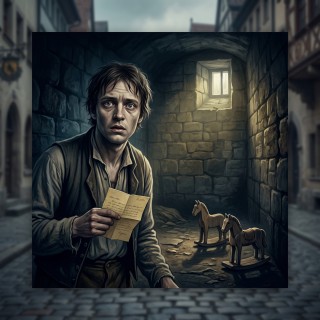
On a serene Whit Monday in May 1828, a curious figure shuffled into the bustling marketplace of Nuremberg, Germany. He was a teenager, perhaps 16 or 17, dressed in the garb of a peasant, but his gait was faltering, his eyes wide with a mixture of terror and bewilderment. He clutched a sealed letter, which, when opened by a local shoemaker, revealed an astonishing tale. The letter, seemingly from an anonymous laborer, claimed the boy, named Kaspar Hauser, had been kept in strict confinement since infancy. He was to be taken to the 6th Cavalry Regiment, where his father, now deceased, had once served. This was the dramatic entrance of one of history’s most perplexing enigmas.
Kaspar himself was largely inarticulate, barely able to string together coherent sentences. His vocabulary was severely limited, and he exhibited a profound unfamiliarity with the most basic aspects of human society. He was mesmerized by candlelight, recoiled from strong smells, and could only eat bread and water. Most strikingly, he claimed to have spent his entire life in a small, dark cell, with only two wooden horses for companionship. He spoke of a ‘man’ who would occasionally bring him food and water, but whose face he never saw. This ‘man’ had taught him to write his name, Kaspar Hauser, and a few rudimentary phrases.
News of the ‘Wild Boy of Nuremberg’ spread like wildfire across Europe. He became an instant sensation, a living embodiment of the ‘noble savage’ concept popular at the time. Intellectuals, scientists, and the public alike flocked to see him, eager to unravel the mystery of his origins. Was he a feral child, raised in isolation? A victim of unspeakable cruelty? Or was he, as some whispered, a high-born prince, hidden away to prevent him from claiming a rightful inheritance?
Kaspar’s education began under the tutelage of various academics and philanthropists. He learned to speak, read, and write with remarkable speed, and his artistic talents, particularly in drawing, blossomed. As he gained more linguistic proficiency, he elaborated on his ‘dungeon’ narrative, providing more vivid, albeit sometimes contradictory, details. These accounts fueled both widespread sympathy and growing skepticism.
However, Kaspar’s burgeoning normalcy was repeatedly punctuated by violence. In October 1829, he was found with a gash on his forehead, claiming he had been attacked by the ‘man’ who had kept him imprisoned. The attacker, he alleged, had said, ‘You still have to die before you leave the city of Nuremberg.’ Later, in 1831, after moving to Ansbach under the guardianship of Lord Stanhope, a prominent English nobleman, Kaspar was shot and wounded, again claiming it was the ‘man’ from his past. This time, he was found with a cryptic note, supposedly from his assailant, hinting at his royal lineage and challenging anyone to prove it.
Then, on December 14, 1833, the final, tragic act unfolded. Kaspar, just 21 years old, stumbled back to Lord Stanhope’s house, a dagger wound in his side. He claimed a stranger had lured him to the Hofgarten, promising revelations about his true identity, only to stab him. Three days later, Kaspar Hauser died. The knife, found at the scene, was of poor quality and seemed unlikely to inflict a fatal wound, adding another layer of doubt to his story.
The death of Kaspar Hauser ignited a furious debate that continues to this day. Was he a tragic victim, relentlessly pursued by a powerful, shadowy figure determined to silence him? Or was he a brilliant fraud, a master manipulator who fabricated his entire story for attention and sympathy? The inconsistencies in his narratives, the seemingly self-inflicted wounds, and the lack of conclusive evidence for any of his claims have led many to suspect a hoax. Yet, the sheer scale of his alleged deception, the unwavering conviction of his supporters, and the palpable suffering he endured make the idea of a simple fraud equally difficult to accept.
Modern DNA analysis, conducted in the late 20th and early 21st centuries on blood samples believed to be Kaspar’s, has yielded conflicting results, further muddying the waters. Some tests suggest no relation to the Baden royal family, while others hint at a possible connection. The mystery of Kaspar Hauser remains one of the most compelling cold cases in history, a testament to the enduring power of an unsolved enigma, forever blurring the lines between fact and fiction, victim and deceiver. What truly happened to the boy from the dark, and who, if anyone, was responsible for his fate? The answers, it seems, are still locked away in the shadows of the past.