S01:E06
The Brilliant Empire: Spies, Giants of the Sea, and the Mighty Ming Dynasty
Imagine starting your life as an orphaned peasant, starving in a war-torn country, and ending up as the absolute ruler of the most powerful nation on Earth. Sounds like a fantasy movie, right? But for a man named Zhu Yuanzhang, this was real life. He founded the Ming Dynasty (1368–1644), an era of epic construction, legendary sea voyages, secret ninja-like imperial guards, and some of the most stunning art in human history. Let’s dive into the action-packed world of the Ming Dynasty—where history gets wild!
The Rise of the Peasant Emperor In the mid-14th century, China was ruled by the Mongol-led Yuan Dynasty. Times were incredibly tough: devastating plagues, terrible floods, and deadly famines ravaged the land. Zhu Yuanzhang lost his entire family to starvation and became a wandering monk, begging for food just to survive. But Zhu wasn’t destined to stay a beggar. He joined a rebel group known as the Red Turbans, who wanted to overthrow the Mongols. Thanks to his brilliant battle strategies, fierce courage, and natural leadership, he quickly rose through the ranks. He led his rebel army to victory, kicked out the Mongol rulers, and crowned himself the Hongwu Emperor. He named his new empire ‘Ming,’ which means ‘Brilliant’ or ‘Bright.’ Talk about the ultimate glow-up!
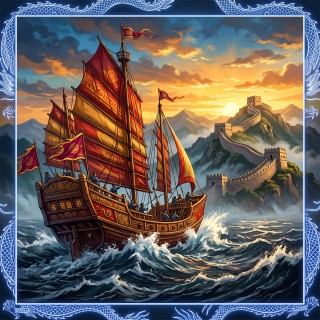
The Colossal Treasure Fleet If you think Christopher Columbus’s ships were impressive, wait until you hear about Admiral Zheng He. In the early 1400s, the Yongle Emperor (the third Ming emperor) ordered the construction of a mind-blowing naval fleet to explore the world and show off China’s immense wealth. Zheng He, a towering explorer, led seven massive voyages across the Indian Ocean, reaching all the way to Southeast Asia, India, Arabia, and East Africa.
But how big were these ships? Zheng He’s flagships, known as ‘Treasure Ships,’ were up to 400 feet long and 150 feet wide. That’s larger than a modern football field! In comparison, Columbus’s flagship, the Santa Maria, was only about 75 feet long. Imagine a fleet of hundreds of these giant wooden castles sailing the ocean, packed with luxurious silk, fine porcelain, and gold, returning to China with exotic treasures and animals like giraffes (which the Chinese court believed were mythical Qilin monsters) and zebras. It was the ultimate display of global power.
The Forbidden City: No Outsiders Allowed To cement his supreme authority, the Yongle Emperor moved the empire’s capital to Beijing and built the Forbidden City. This massive palace complex consists of 980 buildings and is rumored to have 9,999 and a half rooms (because only heaven could have a perfect 10,000!). It was surrounded by high walls and a deep moat. Why was it called ‘Forbidden’? Because ordinary citizens were strictly banned from entering. If you sneaked in without permission, the punishment was instant execution. Inside, the Emperor lived like a god, protected by his personal bodyguards: the Jinyiwei. These were the Emperor’s elite secret police. They wore gorgeous, embroidered silk robes and carried deadly ‘Spring-Autumn’ swords, operating as spies to sniff out any rebellion.
Upgrading the Great Wall When you picture the Great Wall of China today—with its grand stone towers and winding brick paths climbing up dramatic mountain ridges—you are actually looking at the work of the Ming Dynasty. Earlier dynasties built walls out of packed dirt, clay, and wood, which easily eroded over time. The Ming emperors, remembering the threat of northern invaders, decided they needed something much stronger. They rebuilt the wall using millions of heavy stone blocks and kiln-fired bricks. They added thousands of watchtowers, troop barracks, and signal stations where smoke signals could send military messages across miles in just minutes.
Porcelain, Pop Culture, and the Final Fall The Ming Dynasty wasn’t just about war and giant buildings; it was also a golden age of culture and trade. This was the era of the famous ‘Ming Vases’—beautiful white porcelain painted with intricate cobalt-blue dragons and floral patterns. These pieces of art were so highly prized that European kings and queens would trade entire fortunes just to own one.
But even the most brilliant empires eventually fade. By the early 1600s, corruption inside the royal court, freezing weather caused by the ‘Little Ice Age’ (which ruined crops and caused widespread starvation), and expensive wars drained the Ming treasury. In 1644, when a massive peasant rebellion breached the gates of Beijing, the last Ming emperor, Chongzhen, realized all hope was lost. In a dramatic final act, he climbed a hill behind the Forbidden City and hanged himself from a tree. The Ming Dynasty was over, but it left behind a legacy of wonder, art, and architectural marvels that still captivate the world today.