S01:E97
The Cataclysmic Echo: Halifax’s Moment of Unimaginable Destruction
The year is 1917. The Great War rages across Europe, a maelstrom of steel and blood that has consumed millions. But on the other side of the Atlantic, in the seemingly serene harbour of Halifax, Nova Scotia, a different kind of horror was about to unfold – one that would etch itself into the very fabric of Canadian history and redefine the meaning of accidental disaster. This is the story of the Halifax Explosion, the largest human-made accidental explosion before the atomic bomb, a testament to the devastating power of misplaced cargo and the fragility of peace amidst wartime pressures.
Halifax, a vital port during World War I, served as a crucial hub for convoys carrying troops, supplies, and munitions across the treacherous Atlantic. Its harbour, a natural marvel, was a hive of activity, constantly buzzing with naval vessels, merchant ships, and tugboats. It was into this bustling environment on the morning of December 6th, 1917, that two ships, seemingly on routine voyages, were set on a catastrophic collision course.
One was the SS Mont-Blanc, a French cargo vessel laden with a deadly payload. Her holds were packed with approximately 2,925 tonnes of highly volatile explosives, including picric acid, TNT, guncotton, and benzol. She was, in essence, a floating bomb, travelling unescorted and dangerously under-flagged for her hazardous cargo. Her destination: Bordeaux, France, where her deadly contents were destined to fuel the Allied war effort. The other vessel was the SS Imo, a Norwegian relief ship, outbound for New York to pick up supplies for Belgium. Ironically, the Imo was travelling light, its holds virtually empty, a stark contrast to the explosive behemoth she was about to encounter.
The collision occurred in the narrowest part of the harbour, the Narrows. Contributing factors were numerous: a busy shipping lane, insufficient pilotage, and perhaps a degree of miscommunication and misjudgment on both sides. The Mont-Blanc, flying no warning flags despite its perilous cargo, was attempting to navigate through the channel when the Imo, inexplicably on the wrong side of the channel, veered into its path. A desperate last-minute maneuver by the Mont-Blanc’s pilot, attempting to pass port-to-port, failed. The Imo’s bow sliced into the Mont-Blanc’s starboard side, rupturing her forward holds.
The immediate aftermath was not an explosion but a fire. Benzol, a highly flammable liquid carried on the Mont-Blanc’s deck, ignited, sending towering plumes of black smoke into the crisp morning air. For nearly twenty minutes, the Mont-Blanc drifted, a blazing inferno, pushed by the tide towards the Halifax waterfront. Spectators, unaware of the ship’s deadly contents, gathered to watch the spectacular blaze, some even rushing closer for a better view. Firefighters arrived, prepared to battle a ship fire, but utterly unprepared for the cataclysm that was about to engulf them.
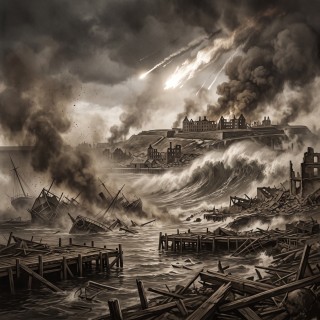
At 9:04:35 AM, the Mont-Blanc erupted. The explosion was instantaneous and devastating, generating an estimated 2.9 kilotons of TNT equivalent – a force comparable to a small tactical nuclear weapon. A blinding white flash momentarily illuminated the sky, followed by a shockwave that tore through Halifax and its surrounding communities. Buildings within an 800-meter radius of the explosion were obliterated, reduced to kindling and rubble. The North End of Halifax, a densely populated working-class neighbourhood, was virtually wiped off the map. Glass shattered for miles, even as far as Truro, 100 kilometers away. The air pressure wave alone was enough to level structures and toss people through the air.
But the destruction didn’t end with the initial blast. A massive tsunami, reaching heights of up to 18 meters, surged through the harbour, sweeping ships ashore and dragging people out to sea. Fires, ignited by overturned stoves and gas lamps in shattered homes, raged uncontrollably, fuelled by debris and broken timbers. The Mont-Blanc herself was vaporized; pieces of her anchor, weighing over half a ton, were found kilometers inland. The Imo, though further away, was lifted by the tsunami and deposited on the Dartmouth shore, severely damaged but largely intact.
The human toll was horrific. Approximately 2,000 people were killed instantly or died soon after from their injuries. Over 9,000 more were injured, many severely, suffering from burns, shrapnel wounds, and horrific eye injuries caused by flying glass. Entire families were wiped out, and countless children were orphaned. The city’s infrastructure was crippled; hospitals were overwhelmed, and communication lines were severed. Despite the overwhelming devastation, a remarkable outpouring of aid followed. Relief efforts poured in from across Canada and the United States, demonstrating an incredible spirit of resilience and solidarity.
The Halifax Explosion serves as a chilling reminder of the unforeseen consequences of wartime pressures and human error. It spurred significant changes in maritime safety regulations, including improved pilotage, communication protocols, and the mandatory display of warning signals for vessels carrying dangerous cargo. More than a century later, the scar on Halifax’s landscape has healed, but the memory of that fateful morning endures, a powerful, sobering lesson etched into the collective consciousness of a city that rose from the ashes of unimaginable destruction.