No transcript available for this episode.
S01:E86
The Cod Wars: When Trawlermen Taught the Royal Navy a Lesson
Imagine a David and Goliath struggle, not in ancient lands, but in the icy, unforgiving waters of the North Atlantic. This isn’t a fable of mythological beasts, but a true story of audacious bravery, geopolitical maneuvering, and the unlikely triumph of a small island nation over a global superpower. Welcome to the Cod Wars, a series of naval confrontations between Iceland and the United Kingdom that, from the 1950s to the 1970s, repeatedly saw the mighty British Royal Navy outmaneuvered and, dare we say, humiliated by a fleet of determined Icelandic trawlers. These weren’t battles fought with cannons and torpedoes, but with wit, sheer grit, and an ingenious weapon: the net cutter.
The seeds of the Cod Wars were sown in the cold, nutrient-rich waters surrounding Iceland, a nation whose very existence has always been inextricably linked to the sea. Fish, particularly cod, wasn’t just a commodity; it was the lifeblood of the Icelandic economy and culture. For centuries, British trawlers had enjoyed unfettered access to these rich fishing grounds, but as scientific understanding of marine ecosystems grew, so too did Iceland’s concern for the sustainability of its primary resource. Starting in the mid-20th century, Iceland began unilaterally extending its exclusive fishing limits, first from 3 to 4 nautical miles in 1952, then to 12 in 1958, 50 in 1972, and finally, to a staggering 200 nautical miles in 1975. Each extension was met with fierce resistance from the United Kingdom, whose distant-water trawling industry relied heavily on these same fishing grounds.
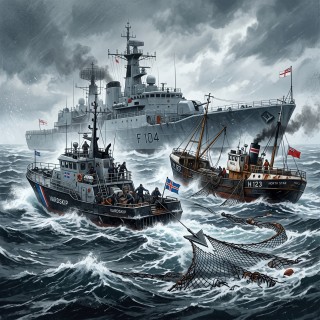
The British government, accustomed to projecting power globally, viewed these Icelandic declarations as illegal infringements on international waters and the rights of its fishermen. They responded, predictably, by deploying the Royal Navy to protect their trawlers. What ensued was a bizarre, almost surreal, ballet of cat and mouse in the North Atlantic. The Royal Navy’s frigates and tugboats, built for grander engagements, found themselves ill-suited for the task of guarding fishing vessels against nimble, purpose-built Icelandic patrol boats and their secret weapon: the net cutter.
These net cutters, simple yet devastating devices, were designed to snag and slice through the trawl nets of British fishing vessels. The Icelandic strategy was ingenious in its simplicity: don’t sink the ships, just destroy their ability to fish. This tactic was incredibly effective. A cut net meant not only lost catch but also costly repairs and downtime, a severe economic blow to the British trawler owners. The Icelandic Coast Guard, often outnumbered and outgunned, executed these operations with audacious skill, weaving through British naval formations, cutting nets, and then making swift escapes, often under the very noses of Royal Navy warships.
The confrontations were often tense and occasionally violent. There were ramming incidents, warning shots fired, and even a few collisions that left ships damaged. British naval vessels attempted to physically block Icelandic patrol boats, but the Icelanders, driven by a fierce determination to protect their livelihoods, proved remarkably resilient and resourceful. The international community largely sided with Iceland’s right to protect its natural resources, especially as the concept of Exclusive Economic Zones (EEZs) began to gain traction globally.
Public opinion in Britain was divided. While the trawler industry demanded protection, many in the public questioned the wisdom of using naval assets to defend fishing rights against a NATO ally. The economic cost of deploying the Royal Navy was substantial, and the diplomatic strain on Anglo-Icelandic relations was immense. Ultimately, the cumulative effect of damaged nets, diplomatic pressure, and the sheer tenacity of the Icelanders proved too much for the United Kingdom. In 1976, after the third Cod War, Britain capitulated, recognizing Iceland’s 200-nautical-mile exclusive economic zone. This marked a watershed moment in international law, paving the way for the universal adoption of EEZs and fundamentally altering how nations manage their marine resources.
The Cod Wars stand as a testament to the idea that even the smallest nation, when driven by a fundamental need and equipped with ingenuity and resolve, can stand up to and ultimately prevail against seemingly insurmountable odds. It was a conflict where economic survival trumped naval might, and where the humble fishing net became a more powerful weapon than many an artillery shell. The Royal Navy, accustomed to projecting power across empires, learned a humbling lesson in the icy waters of the North Atlantic: sometimes, the greatest battles are not won by brute force, but by a cunning strategy and an unwavering will to survive. The legacy of the Cod Wars endures, a fascinating footnote in naval history and a powerful reminder of the intricate relationship between economics, sovereignty, and the sea.