No transcript available for this episode.
S01:E33
The Code of Life: How Charles Darwin Unlocked the Secrets of Nature
Imagine stepping aboard a cramped, wooden warship to embark on a perilous five-year voyage into the unknown, completely unaware that you are about to shatter humanity’s understanding of existence itself. In December 1831, a twenty-two-year-old university graduate named Charles Darwin boarded the HMS Beagle. He was not yet a world-renowned scientist; he was simply an enthusiastic young naturalist with an insatiable curiosity for rocks, beetles, and fossils. Little did the world know that this quiet traveler would spark one of the greatest scientific revolutions in human history.
The voyage of the HMS Beagle was a breathtaking journey around the globe, surveying distant coastlines from the stormy tip of South America to the tropical islands of the Pacific. Everywhere Darwin set foot, he observed nature with an unmatched intensity. In Argentina, he uncovered massive, fossilized skeletons of ancient giant sloths, prompting him to wonder why long-extinct creatures resembled living species, yet remained distinctly different. In Chile, he witnessed violent earthquakes and volcanic eruptions, realizing firsthand that the Earth itself was constantly shifting and evolving over immense spans of time.
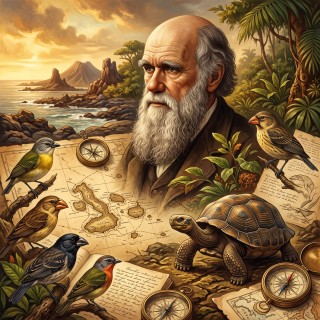
However, it was a remote, volcanic archipelago off the coast of Ecuador that would forever crystallize his revolutionary ideas: the Galápagos Islands. Here, isolated from the mainland, Darwin encountered a living laboratory of extraordinary wildlife. Giant tortoises lumbered across harsh lava fields, and strange marine iguanas plunged into the ocean to graze on algae. But it was the smaller creatures that held the ultimate secret. Darwin collected dozens of specimens of finches across the different islands. At first, he barely noted their differences. But upon returning home and analyzing them alongside expert ornithologists, a stunning realization dawned on him: the finches on each island possessed uniquely shaped beaks, perfectly adapted to their specific food sources. Finches with thick, heavy beaks cracked hard seeds, while those with slender, pointed beaks probed cacti or snatched insects.
Why would slightly different versions of the same bird live on islands just miles apart? Darwin proposed a radical answer: they were all descendants of a single ancestor species that had arrived from the South American mainland long ago. Over thousands of generations, isolated on different islands, the birds had gradually changed and adapted to survive in their unique environments. Nature itself was selecting which traits were passed down.
Upon returning to England in 1836, Darwin painstakingly assembled his observations. He formulated the groundbreaking theory of ‘evolution by natural selection.’ In simple terms, organisms with traits better suited to their environment are more likely to survive, reproduce, and pass those advantageous traits to their offspring. Over vast stretches of time, this subtle mechanism gives rise to new species, branching out like a majestic tree of life.
Yet, Darwin was terrified of his own discovery. He knew his ideas would shock Victorian society, challenging deeply held beliefs about the origin of life. For over two decades, he kept his grand theory largely secret, quietly gathering mountains of evidence, analyzing barnacles, breeding pigeons, and corresponding with trusted scientific peers. He refused to publish until his argument was virtually unassailable.
The ticking clock finally caught up with him in 1858, when a young naturalist named Alfred Russel Wallace sent Darwin a manuscript from the jungles of Malaysia—independently outlining an almost identical theory of natural selection! Shocked into action, Darwin worked frantically to finalize his own manuscript. In November 1859, he published his masterwork: ‘On the Origin of Species by Means of Natural Selection.’
The book was an instant sensation, selling out on its very first day. It ignited fierce, fiery debates across the globe. While many scientists marveled at its logical brilliance, critics fiercely condemned its radical implications. Ultimately, Darwin’s work tore away the old paradigm, revealing a dynamic, interconnected living world where change is the only constant. Today, Charles Darwin’s vision forms the cornerstone of modern biology, forever altering how humanity views its place in the grand tapestry of nature.