No transcript available for this episode.
S01:E30
The Conqueror of the Known World: The Rise and Unstoppable Surge of Alexander the Great
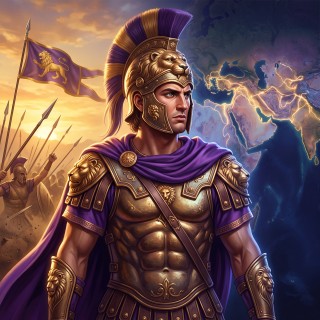
In the summer of 334 BCE, a twenty-two-year-old king stood on the shores of the Hellespont, staring across the narrow strait that separated Europe from Asia. He threw his spear into the soil of Asia Minor and proclaimed that he would accept the continent as a gift from the gods, won by the point of the sword. This was Alexander III of Macedon—a young man whose boundless ambition, military genius, and untamed spirit would reshape the ancient world forever.
Born in 356 BCE in Pella, the capital of Macedon, Alexander was groomed for greatness from his first breath. His father, King Philip II, was a brilliant military reformer who forged the legendary Macedonian phalanx, turning a rural kingdom into a dominant superpower. His mother, Queen Olympias, instilled in him the fierce belief that he was descended from heroes and gods, specifically Achilles and Heracles. To complement this royal martial heritage, Philip hired the finest mind of the age to tutor his son: the great philosopher Aristotle. Under Aristotle’s guidance, Alexander developed an insatiable passion for literature, science, medicine, and philosophy, famously carrying a copy of Homer’s Iliad with him on every campaign.
Alexander’s legendary bravery was demonstrated early. At age twelve, he tamed Bucephalus, a wild, fiery stallion that no adult rider could manage. Spotting what others missed, Alexander noticed the horse was terrified of its own shadow. Turning the beast toward the sun, he calmed it and rode with effortless mastery. Seeing this, Philip famously wept with pride and declared, ‘My son, seek out a kingdom worthy of yourself, for Macedon is too small for you.’
When Philip was assassinated in 336 BCE, Alexander seized the throne at just twenty years old. After ruthlessly securing his power and crushing rebellions across Greece, he turned his sights toward his ultimate objective: the mighty Achaemenid Empire of Persia, the greatest realm the world had ever seen, spanning from Egypt to India.
Crossing into Asia, Alexander brought an army of roughly 35,000 infantry and 5,000 cavalry. What he lacked in sheer numbers compared to the vast Persian hosts, he made up for in tactical flexibility, iron discipline, and relentless offense. At the Gordium, he encountered the famous Gordian Knot—a complex knot of bark rope said to unlock the empire of Asia to whoever untied it. Alexander simply sliced through it with his sword, demonstrating his uncompromising mindset.
In battle after battle, Alexander’s strategic genius stunned his opponents. At the Battle of Issus in 333 BCE and again at the decisive Battle of Gaugamela in 331 BCE, he faced King Darius III of Persia. Rather than engaging the massive Persian front line directly, Alexander deployed visionary tactics. At Gaugamela, he feigned a diagonal movement, creating a fatal gap in the Persian line. Leading his elite Companion Cavalry in a sharp wedge formation, he charged straight at Darius’s personal location. The terrifying momentum broke the Persian morale, sending Darius fleeing and sealing the fate of the empire.
With Persia vanquished, Alexander marched into Egypt, where he was welcomed as a liberator from Persian rule and crowned Pharaoh. Deep in the Libyan desert at the Siwa Oasis, the oracle proclaimed him the son of Zeus-Ammon. He founded the city of Alexandria, which would become the intellectual and cultural jewel of the Mediterranean.
Yet Alexander’s thirst for conquest was insatiable. He pushed his exhausted army further east, crossing rugged mountain ranges and treacherous terrain into ancient India. At the Battle of the Hydaspes River in 326 BCE, he faced King Porus, who deployed massive armored war elephants. Through brilliant amphibious maneuvers and tactical adaptation, Alexander won yet another victory, though at a steep cost—including the death of his beloved horse, Bucephalus. Impressed by Porus’s brave resistance, Alexander restored his defeated rival as a vassal ruler.
It was at the Hyphasis River that Alexander finally met an force he could not conquer: his own soldiers. Weary, homesick, and terrified by rumors of even larger armies deeper in India, his men mutinied, refusing to march any further east. Reluctantly, Alexander yielded, weeping in his tent before turning his forces back toward Babylon.
The return march through the unforgiving Gedrosian Desert proved deadlier than any battle, costing thousands of lives due to heat, dehydration, and starvation. Despite the tragedy, Alexander reached Babylon and began planning new expeditions into Arabia and North Africa. However, in June 323 BCE, after a night of heavy drinking, Alexander caught a sudden, violent fever. Within days, at the age of just thirty-two, the conqueror of the world died.
When asked on his deathbed to whom he left his vast empire, Alexander reportedly replied, ‘To the strongest.’ His sudden death left a power vacuum that shattered his realm into decades of bloody civil war among his generals, known as the Diadochi. Yet, Alexander’s legacy endured. By forging an empire spanning three continents, he initiated the Hellenistic Period, blending Greek, Persian, Egyptian, and Indian cultures, laying the foundation for a vibrant interconnected world that echoes through history to this day.