0:00Intro
The Crimean War: The Dawn of Modern Warfare
In the middle of the nineteenth century, the European continent sat on a powder keg of geopolitical ambition, religious tension, and imperial decline. The spark that ignited this explosive mixture was the Crimean War (1853–1856), a conflict that would drag the world’s greatest empires into a brutal, bloody clash on a remote peninsula in the Black Sea. Often called the first ‘modern’ war, it bridged the gap between the romanticized era of Napoleon and the mechanized, industrialized slaughter of the twentieth century.
At the heart of the crisis was the decaying Ottoman Empire, widely dubbed the ‘Sick Man of Europe.’ Seeking to exploit this weakness, Tsar Nicholas I of Russia cast hungry eyes southward, aiming to secure warm-water ports and expand Russian influence into the Balkans. Claiming the right to protect Orthodox Christian subjects within the Ottoman realm, Russia pushed its forces forward. But Great Britain and France watched this expansion with growing dread. A Russian empire dominant in the Mediterranean would threaten British trade routes to India and upset the delicate European balance of power. Thus, an unlikely alliance was born: the British Empire, the French Empire, and the Ottoman Empire, later joined by the Kingdom of Sardinia, united to halt the Russian colossus.
The primary theater of war became the Crimean Peninsula. In September 1854, allied forces landed on the shores of Crimea, setting their sights on Sevastopol—the heavily fortified home port of Russia’s Black Sea Fleet. What followed was a grueling, year-long siege that tested the absolute limits of human endurance. The battlefields of the Crimea became synonymous with unimaginable suffering, tactical blunders, and astounding heroism.
No event captured this mix of tragedy and bravery more than the Battle of Balaclava on October 25, 1854. Due to a series of catastrophic miscommunications among the British high command, the Light Cavalry Brigade was ordered to charge directly into a valley surrounded on three sides by heavy Russian artillery. Armed with only sabers and lances, the six hundred horsemen rode gallantly into what Alfred, Lord Tennyson later immortalized as the ‘Valley of Death.’ Though they reached the guns in a display of breathtaking courage, they were decimated, losing over a third of their strength in a matter of minutes. It was a stark reminder of how industrial firepower had rendered old-world cavalry tactics completely obsolete.
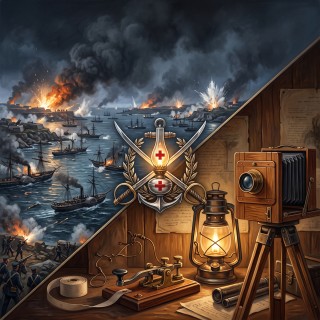
Yet, the Crimean War was not just a story of battlefield slaughter; it was a watershed moment in human history due to its technological and social innovations. This was the world’s first media war. Thanks to the newly invented electric telegraph, news from the front lines traveled to London and Paris in hours rather than weeks. The public read raw, unvarnished accounts of the horrific conditions, the freezing winters, and the incompetence of their leaders. Furthermore, the pioneering work of Roger Fenton, one of the first war photographers, brought the stark, haunting reality of the battlefield directly into Victorian living rooms, changing the public perception of war forever.
This instant public awareness sparked outrage and demanded change, particularly regarding the treatment of wounded soldiers. Enter Florence Nightingale, ‘The Lady with the Lamp.’ Arriving at the squalid military hospital in Scutari, Nightingale and her team of dedicated nurses transformed medical care. By introducing strict sanitary measures, clean water, and proper ventilation, they dragged military medicine into the modern era, drastically lowering mortality rates and laying the foundation for professional nursing worldwide.
By September 1855, after eleven months of relentless bombardment and bloody infantry assaults, Sevastopol finally fell. The Russian defenders blew up their own fortifications and retreated. Exhausted and facing economic ruin, Russia sued for peace. The Treaty of Paris, signed in 1856, demilitarized the Black Sea and guaranteed the integrity of the Ottoman Empire, temporarily checking Russian expansion.
The legacy of the Crimean War, however, stretched far beyond the borders of the Black Sea. It shattered the long peace established after the Napoleonic Wars and sowed the seeds of future European rivalries. It forced a humiliated Russia to look inward, sparking massive domestic reforms, including the emancipation of the serfs in 1861. For Britain and France, it revealed deep systemic flaws in their military organizations. Ultimately, the Crimean War served as a grim preview of the global, total warfare that would consume the world in the century to follow.