No transcript available for this episode.
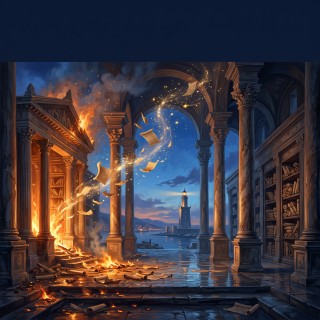
S01:E61
The Day the Library of Alexandria Burned: Myth, Fire, and the Truth Behind History’s Greatest Loss
For over two millennia, the destruction of the Great Library of Alexandria has stood as civilization’s ultimate tragedy—a catastrophic apocalypse of knowledge where the accumulated genius of the ancient world was allegedly reduced to ash in a single, apocalyptic night. In popular imagination, a monstrous wall of flame engulfed marble halls, consuming lost works of philosophy, celestial maps, and secret histories, plunging humanity directly into the Dark Ages. But does this cinematic catastrophe match historical reality? Who really struck the match, and what vanished into the smoke?
Founded around 300 BCE by Ptolemy I Soter, the Library of Alexandria was an unprecedented intellectual powerhouse. Built within the royal palatial district of Bruchion, its mission was astonishingly ambitious: to collect a copy of every scroll written on Earth. Harbor authorities seized every book on arriving ships, copied them, kept the originals, and returned mere duplicates to the owners. At its zenith, the collection is estimated to have held between 40,000 and 400,000 papyrus rolls. Yet, the persistent legend that a single tyrant or single fire obliterated this treasure trove is an enduring historical myth.
The first famous suspect is Julius Caesar. In 48 BCE, besieged in Alexandria during the civil war between Cleopatra and her brother Ptolemy XIII, Caesar ordered his soldiers to set fire to the Egyptian fleet docked in the harbor. The blaze leaped from ship to ship and spread inland to dockside warehouses. Ancient writers like Seneca and Plutarch claim that tens of thousands of scrolls burned. However, modern historians largely agree that while harbor storage facilities containing export grain and commercial books were decimated, the main Library—safely tucked deeper in the Bruchion quarter—most likely survived. Caesar himself remained silent on burning any grand institution of learning in his memoirs.
The second major blow came three centuries later, in the 270s CE. Roman Emperor Aurelian led a ferocious campaign to reclaim Alexandria from the breakaway Queen Zenobia of Palmyra. In the savage urban warfare that followed, the entire royal district of Bruchion, including the original Library building, was utterly leveled. If any portion of the original Great Library still functioned in its ancestral home, Aurelian’s legionaries likely brought about its physical annihilation.
Yet, the spirit of Alexandrian scholarship had already migrated to the ‘daughter library’ housed within the Serapeum, a majestic temple complex dedicated to the god Serapis. This brings us to the third famous flashpoint: 391 CE. Religious tensions boiled over when Emperor Theodosius I outlawed pagan worship. Under the incitement of Patriarch Theophilus of Alexandria, a Christian mob stormed and dismantled the Serapeum. Contemporary records confirm the temple’s destruction, and later historians noted that the book cupboards stood tragically empty—looted or dispersed in the ideological purge.
A fourth myth surfaced centuries later, pinning the final disaster on the Muslim conquest in 642 CE. A medieval legend claimed that Caliph Omar decreed that if books agreed with the Quran, they were redundant, and if they disagreed, they were blasphemous, ordering them burned to heat the city’s public baths for six months. However, 20th-century historiography thoroughly debunked this narrative as 12th-century political propaganda; by the 7th century, the Great Library had already ceased to exist for hundreds of years.
The real culprit behind the fall of the Library of Alexandria was far more mundane than a spectacular inferno: slow neglect, shifting political priorities, budget cuts, climate, and the natural decay of fragile papyrus in the humid Mediterranean air. Without continuous state funding to recopy crumbling scrolls onto fresh parchment, the library withered away scroll by scroll.
What did we actually lose? We lost the lost plays of Aeschylus, Sophocles, and Euripides, of which only a tiny fraction survive today. We lost Aristarchus of Samos’s early treatise detailing how the Earth revolves around the Sun—a heliocentric breakthrough 1,800 years before Copernicus. We lost the complete anatomical studies of Herophilus and the exhaustive Babylonian and Persian astronomical logs. The tragedy of Alexandria is not that a villain burned the world’s wisdom overnight, but that civilization allowed it to slip away through fire, fanaticism, and sheer neglect.