S01:E104
The Day the Sky Turned to Blood (1883): How Krakatoa’s Roar Echoed Through History and Art
August 27, 1883. A date etched into the annals of both geological cataclysm and human artistic inspiration. On that fateful day, the island volcano of Krakatoa, nestled in the Sunda Strait between Java and Sumatra, unleashed a fury so immense that its echoes reverberated across continents, literally and figuratively. This wasn’t merely an eruption; it was a planetary shriek, the loudest sound ever recorded by humanity, a sound that painted the sky crimson and ignited the imagination of an artist whose work would become an icon of existential dread.
For months leading up to the cataclysm, Krakatoa had been stirring. Fishermen reported strange rumblings, and minor eruptions cast ash over nearby islands. But nothing prepared the world for the paroxysmal events of August 27th. At approximately 10:02 AM local time, Krakatoa exploded with an unimaginable force, equivalent to roughly 200 megatons of TNT – a detonation four times more powerful than the largest thermonuclear bomb ever tested. The sheer scale of the eruption was staggering. It pulverized two-thirds of the island, creating a caldera seven kilometers wide and plunging thousands of feet deep.
The immediate effects were devastating. A series of colossal tsunamis, some reaching heights of 40 meters, ravaged coastal towns and villages, claiming over 36,000 lives. The atmospheric shockwave generated by the explosion was truly global. It traveled around the Earth at least three and a half times, detected by barographs as far away as London and New York. Sailors hundreds of miles away reported eardrums bursting, and windows shattered in Batavia (modern-day Jakarta), over 100 miles distant. The roar was heard clearly in Perth, Australia, nearly 2,000 miles away, and on the island of Rodrigues, almost 3,000 miles away. This makes the Krakatoa eruption the loudest sound ever reliably documented in recorded history, a sound that could literally be heard across an entire ocean.
But Krakatoa’s impact wasn’t confined to immediate destruction and auditory shockwaves. The eruption injected vast quantities of ash and sulfur dioxide into the stratosphere, circulating globally for years. This atmospheric veil led to spectacular and unnerving phenomena worldwide. Sunsets became extraordinarily vivid, painted in fiery reds, oranges, and purples – an apocalyptic palette that fascinated and frightened observers across Europe, North America, and beyond. Scientists at the time meticulously documented these atmospheric effects, marveling at the prolonged twilight glows and unusual optical displays.
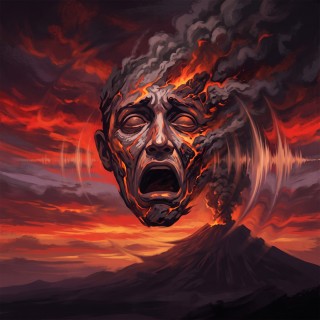
It was these dramatic, blood-red sunsets that profoundly impacted the Norwegian artist Edvard Munch. Around 1892-1893, nearly a decade after the eruption, Munch was living in Oslo (then Christiania) and experiencing deep personal turmoil. One evening, as he walked with friends, he witnessed a sunset unlike any he had ever seen. The sky, he later recounted, turned ‘blood-red.’ Overwhelmed by a sense of existential dread and the palpable ‘scream’ of nature, he produced what would become his most famous work, The Scream. While Munch never explicitly stated Krakatoa as the direct inspiration, the chronological proximity of the eruption’s atmospheric effects and the consistent descriptions of the sky in his diary entries strongly suggest a powerful, subconscious influence.
Munch’s iconic depiction of a distorted, anguished figure against a swirling, blood-red sky perfectly encapsulates the primal fear and overwhelming sensory experience that the Krakatoa eruption evoked globally. The visual legacy of Krakatoa’s atmospheric aftermath became intertwined with Munch’s personal anxieties, creating a universal symbol of human despair and the raw, untamed power of nature. From a geological cataclysm to a masterpiece of expressionist art, Krakatoa’s roar truly echoed through history, leaving an indelible mark on both our planet and our collective artistic consciousness.