No transcript available for this episode.
S01:E94
The Earth Whispered: Unearthing China’s Silent Army
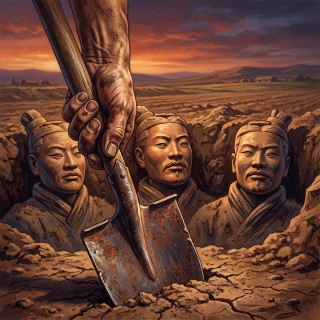
March 1974. The sun, a relentless orb in the Chinese sky, beat down on the parched earth of Lintong County, Shaanxi province. For generations, the land had yielded meager harvests, its secrets buried deep beneath layers of dust and time. On this particular day, however, a group of farmers, led by the stoic Yang Zhifa, were not searching for sustenance but for water. A persistent drought had gripped the region, threatening their very livelihoods. Their simple task – digging a well, a lifeline in the unforgiving landscape – was about to unearth a discovery that would rewrite history and captivate the world.
As their picks and shovels bit into the dry soil, they encountered something unexpected. Not rock, not clay, but a hard, reddish material. Curiosity piqued, they dug deeper, only to unearth a bronze arrowhead, then fragments of pottery. What began as a desperate search for water soon transformed into an archaeological lottery. The farmers, accustomed to the mundane rhythms of rural life, could not have fathomed the monumental significance of their find. They had stumbled upon the first, tantalizing glimpses of what would become known as the Terracotta Army.
Word, as it always does, traveled. Initially, local officials dismissed the findings as little more than ancient debris. But the sheer scale of the fragments, the undeniable artistry of the pottery shards, soon demanded greater attention. Archaeologists were dispatched, their skepticism quickly replaced by awe. As the soil was carefully removed, layer by painstaking layer, the earth began to surrender its secrets. First, a head emerged, then a torso, then a fully formed, life-sized warrior, standing silently in the subterranean darkness for over two millennia. Each figure was a testament to unparalleled craftsmanship, a silent sentinel guarding an emperor’s eternal sleep.
The initial pit, now known as Pit 1, revealed a breathtaking spectacle: rows upon rows of terracotta soldiers, each unique in its facial features, hair, and armor. Archers, infantrymen, charioteers – a meticulously organized army frozen in time, poised for battle. The scale was unimaginable. This wasn’t merely a tomb; it was a vast, subterranean necropolis, a military complex designed to accompany China’s first emperor, Qin Shi Huang, into the afterlife. His megalomaniacal vision, his insatiable desire for eternal power, had manifested in an army of clay, an unprecedented testament to human ambition and artistic prowess.
Subsequent excavations revealed not just one pit, but three, and countless other associated findings, including bronze chariots, weapons, and even entertainers. The Terracotta Army was not a standalone marvel but part of an elaborate mausoleum complex, a sprawling city of the dead, reflecting the grandeur and ruthlessness of the Qin Dynasty. Each warrior, weighing hundreds of pounds, was intricately crafted, fired at immense temperatures, and originally painted in vibrant hues that have long since faded, leaving behind the somber, earthy tones we see today. Their faces, a mosaic of expressions, hint at the diverse peoples and cultures that formed Qin Shi Huang’s empire.
The discovery sent shockwaves across the globe. It fundamentally reshaped our understanding of ancient Chinese history, art, and military organization. It provided invaluable insights into the social structure, technological capabilities, and religious beliefs of a civilization that, for centuries, had remained veiled in legend. The sheer scale and preservation of the Terracotta Army offered a tangible link to a bygone era, allowing historians and archaeologists to piece together the narrative of an empire that unified China for the first time.
Today, the Terracotta Army stands as one of the most significant archaeological finds of the 20th century, a UNESCO World Heritage site, and a global pilgrimage destination. It’s a powerful reminder that history often lies hidden in plain sight, waiting for an unsuspecting shovel, a curious hand, or a simple search for water to bring its forgotten stories to light. The farmers of Lintong County, on that hot March day in 1974, didn’t just dig a well; they unearthed a silent army, and with it, a profound chapter of humanity’s enduring legacy.