S01:E120
The Emperor of the United States: A Crown of Whimsy and a City’s Love
In the bustling, gold-fueled San Francisco of the mid-19th century, a city brimming with ambition, innovation, and no small amount of eccentricity, one figure transcended mere oddity to become a beloved, if self-proclaimed, monarch. This was Joshua Abraham Norton, a man whose remarkable journey from failed businessman to the “Emperor of the United States and Protector of Mexico” is a testament to the power of collective imagination and the unique spirit of a burgeoning city.
Born in England in 1818, Norton emigrated to South Africa with his parents as a child. He arrived in San Francisco in 1849, armed with a modest fortune and an entrepreneurial spirit, hoping to capitalize on the California Gold Rush. He quickly made a name for himself as a shrewd, if sometimes impulsive, businessman, dabbling in real estate and commodities. By the early 1850s, he was a respected member of the financial community, albeit one prone to high-stakes gambles. His fortunes took a dramatic turn in 1857 when he attempted to corner the rice market. A glut of Peruvian rice arrived unexpectedly, driving prices down and bankrupting Norton. The ensuing legal battles drained his remaining resources and, some believe, his sanity.
It was two years later, on September 17, 1859, that Joshua Norton, having lost everything but his dignity (and perhaps a touch of his mind), walked into the offices of the San Francisco Bulletin and issued a proclamation that would forever etch his name into the annals of American folklore. “At the peremptory request of a large majority of the citizens of these United States,” he declared, “I, Joshua Norton, presently of San Francisco, California, declare and proclaim myself Emperor of these United States.” A few years later, he added “Protector of Mexico” to his growing list of titles, apparently to ensure Latin American stability.
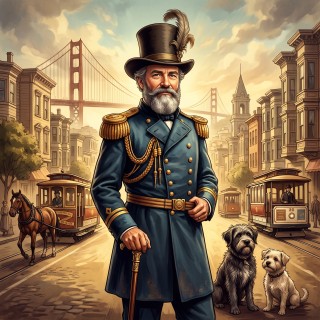
What happened next is truly extraordinary. Instead of being dismissed as a lunatic, Norton was embraced. San Franciscans, known for their independent streak and their appreciation for a good story, took to their self-appointed Emperor with surprising warmth. He eschewed the trappings of a traditional monarch, instead adopting a distinctive blue uniform with gold epaulets, a feathered beaver hat, and a cane or umbrella. He would patrol the streets of his “empire” daily, often accompanied by his two loyal stray dogs, Lazarus and Bummer, who themselves became local celebrities.
Emperor Norton’s proclamations, often published in local newspapers (who, for a small fee, were happy to oblige their monarch), ranged from the sublime to the utterly absurd. He demanded the dissolution of the United States Congress, arguing that its divisions were tearing the nation apart. He ordered the construction of a bridge-tunnel connecting San Francisco to Oakland, a visionary idea decades ahead of its time. He even issued his own currency, scrip notes that were accepted by many local businesses, often out of respect and affection for the Emperor.
Businesses proudly displayed signs proclaiming themselves ‘By Appointment to His Imperial Majesty, Emperor Norton I.’ Restaurants offered him free meals, and theaters reserved a special box for his attendance. When a zealous police officer once dared to arrest Norton for disturbing the peace, the public outcry was immediate and fierce. The chief of police, embarrassed, ordered Norton’s immediate release and issued an apology, instructing his officers to treat the Emperor with the utmost respect. From that day forward, San Francisco’s police saluted him when he passed.
Emperor Norton served as a living embodiment of San Francisco’s unique character – its irreverence, its generosity, and its willingness to embrace the unconventional. He offered a touch of theatricality and escapism in a city that was rapidly modernizing. He was a harmless, beloved figure who brought smiles to faces and inspired a sense of shared community. He became a symbol of the city’s independent spirit, a reminder that one didn’t always have to conform.
His reign lasted for 21 years. On January 8, 1880, Emperor Norton collapsed on a San Francisco streetcar on his way to a lecture at the California Academy of Sciences. He died shortly thereafter, a pauper by conventional standards, but a monarch in the hearts of San Franciscans. His funeral was a monumental event. Thousands lined the streets, and his casket was carried by members of the Pacific Club, a prestigious organization whose members he had once counted among his peers. The San Francisco Chronicle’s obituary read simply, “Le Roi est Mort” (The King is Dead).
Joshua Norton’s legacy endures. He is celebrated in books, plays, and even a musical. His image appears on souvenirs, and numerous historical markers commemorate his presence. The bridge-tunnel he envisioned eventually became a reality, albeit long after his death. He remains a beloved eccentric, a reminder that sometimes, the greatest titles are those bestowed not by birth or conquest, but by the affection and imagination of a city that dared to dream along with him.