The Empire’s Darkest Hour: The Anglo-Boer War
At the turn of the 20th century, the eyes of the world were transfixed on the southern tip of Africa. Here, a epic struggle was unfolding, pitting the world’s greatest superpower, the British Empire, against two fiercely independent peasant republics: the South African Republic (Transvaal) and the Orange Free State. This was the Second Boer War (1899–1902), a brutal, transformative conflict that would rewrite the rules of modern warfare, expose the dark underbelly of imperialism, and leave a permanent scar on the canvas of history.
The catalyst for this cataclysmic clash was none other than the glittering allure of gold and diamonds. In the late 19th century, the discovery of the world’s richest goldfields in the Witwatersrand transformed the Transvaal from a quiet, agrarian Boer society into an economic powerhouse. Suddenly, the British Empire, driven by ambitious imperialists like Cecil Rhodes, coveted this wealth. Tension escalated as thousands of foreign miners, mostly British citizens known as ‘Uitlanders’, flooded the region. The Boer President, Paul Kruger, fiercely resisted British demands to grant these newcomers voting rights, fearing his people would be politically swamped and their independence lost. By 1899, diplomacy had completely crumbled, and an ultimatum triggered a war that many in London confidently predicted would be over by Christmas.
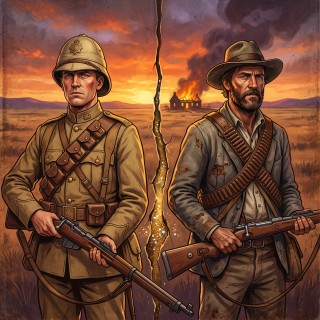
They were tragically wrong. The Boers were not a traditional army; they were citizen-soldiers, farmers organized into highly mobile units called ‘commandos’. Armed with state-of-the-art German Mauser rifles and utilizing smokeless gunpowder, they were master marksmen and horsemen who knew the rugged South African veld intimately. In the opening months, the Boers launched preemptive strikes, trapping British forces in legendary, claustrophobic sieges at Ladysmith, Mafeking, and Kimberley. During a single devastating week in December 1899, known as ‘Black Week’, the British army suffered three consecutive, humiliating defeats at Colenso, Magersfontein, and Stormberg. The mighty Empire was shaken to its absolute core.
Stung by these losses, Great Britain unleashed its full imperial might. They poured hundreds of thousands of troops from across the globe—including Canada, Australia, and New Zealand—into South Africa, under the command of Lord Roberts and Lord Kitchener. By mid-1900, the sheer weight of British numbers turned the tide. Imperial forces marched victoriously into the Boer capitals of Bloemfontein and Pretoria. To the outside world, the war seemed over. But the Boer fighters refused to surrender.
Instead, the conflict entered its darkest and most desperate phase: a relentless guerrilla war. Led by brilliant, elusive commanders like Christiaan de Wet, Louis Botha, and Jan Smuts, Boer commandos vanished into the vast countryside, launching devastating hit-and-run raids on British supply lines, communication wires, and railways. Frustrated and unable to catch the mobile enemy, Lord Kitchener implemented a ruthless ‘scorched earth’ policy. British troops systematically burned Boer farms to the ground, slaughtered livestock, destroyed crops, and poisoned wells to deprive the guerrillas of food and shelter.
Even more controversially, the British rounded up Boer women, children, and Black African farmworkers, packing them into poorly managed concentration camps. Deprived of adequate food, water, sanitation, and medical care, epidemics of measles, typhoid, and pneumonia swept through the tents. Over 26,000 Boer women and children, along with an estimated 20,000 Black Africans, perished in these camps. The international outcry was immense, staining Britain’s humanitarian reputation forever.
By 1902, exhausted, starving, and devastated by the suffering of their families, the Boer leaders realized they could no longer resist. On May 31, 1902, the Treaty of Vereeniging was signed. The Boer republics surrendered their independence, becoming part of the British Empire, though they were promised eventual self-government.
The Boer War was a terrifying preview of the total wars of the 20th century. It pioneered trench warfare, camouflage uniforms, and civilian internment camps, laying the grim tactical groundwork for World War I. Ultimately, it reshaped the geopolitical landscape, leading to the creation of the Union of South Africa in 1910 and sowing the seeds of the complex, tragic social and racial divisions that would plague the nation for decades to come.