0:00Intro
The End of the World: The Cataclysmic Collapse of the Bronze Age
Around 1200 BCE, the civilized world was thriving. From the sandy banks of the Nile to the rugged peaks of Greece, and across the fertile plains of Mesopotamia, humanity had built an astonishingly interconnected global network. Great empires—the Egyptians, the Hittites, the Mycenaeans, and the Babylonians—dominated the landscape. They traded gold, copper, tin, and luxury goods across thousands of miles. They built magnificent palaces, recorded complex laws on clay tablets, and maintained powerful standing armies. This was the golden twilight of the Late Bronze Age. And then, in the span of a single generation, almost all of it vanished into ash.
Imagine waking up to find that every major city in your world has been burned to the ground, trade routes have completely collapsed, writing systems have been forgotten, and the grand structures of civilization have dissolved into chaos. This is not the plot of a post-apocalyptic science fiction movie; it is one of the greatest mysteries in human history: the Late Bronze Age Collapse.
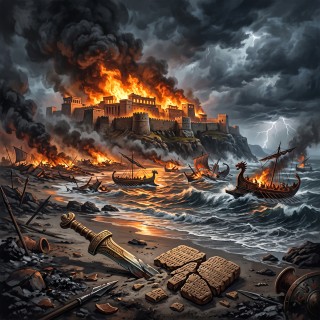
How did such advanced, powerful civilizations crumble so quickly? For decades, historians searched for a single culprit, a “smoking gun.” The most famous suspects are the “Sea Peoples”—a mysterious coalition of seafaring raiders mentioned in ancient Egyptian inscriptions. Pharaoh Ramesses III fought desperate, bloody battles against these terrifying invaders, who arrived in longships, burning coastal cities and displacing entire populations. But were the Sea Peoples the sole cause of this global cataclysm, or were they merely vultures feeding on a dying world?
Modern science has revealed that the collapse was not caused by a single threat, but by a “perfect storm” of interconnected catastrophes. First, nature struck a devastating blow. Paleoclimate data, retrieved from ancient pollen samples and cave stalagmites, reveals that a massive, prolonged megadrought plagued the Mediterranean region around 1200 BCE. Fields withered, rivers dried up, and famine swept through the cities. In an era where empires relied heavily on agricultural surpluses to feed their massive bureaucracies and armies, starvation triggered widespread instability.
As if famine wasn’t enough, evidence suggests a series of violent earthquakes—an “earthquake storm”—rocked the region during this exact period, physically shattering the stone walls of cities like Mycenae and Troy.
With the agricultural base ruined and cities damaged, the highly centralized, top-heavy political systems of the Bronze Age began to buckle. The Bronze Age economy was highly globalized. Bronze, the crucial metal of the era for tools and weapons, required two ingredients: copper and tin. While copper was abundant in Cyprus, tin had to be imported from as far away as modern-day Afghanistan. This meant that if just one link in the trade chain broke, the entire economic engine ground to a halt. When shipping lanes became unsafe due to pirates and land routes were disrupted by starving nomads, the empires could no longer manufacture the bronze they needed to maintain their military dominance.
Inside the palaces, social unrest boiled over. Starving peasants and exploited lower classes likely revolted against their elite rulers, who could no longer protect them or provide food. It was a domino effect of epic proportions. When the Hittite Empire fell, it disrupted trade with Egypt. When the Mycenaean palaces burned, the Aegean sea became a lawless zone. One by one, the dominoes fell: Mycenae, Tiryns, Troy, Hattusa, Ugarit—all destroyed and abandoned.
Only Egypt barely survived, bleeding and exhausted, a shadow of its former self. The rest of the region plunged into a “Dark Age” that lasted for centuries. Literacy rates plummeted; the Mycenaean writing system, Linear B, disappeared entirely.
Yet, out of the ashes of this ancient apocalypse, a new world was born. The collapse of the old empires broke the monopoly on power, allowing smaller, more resilient cultures to emerge. The Phoenicians took to the seas, spreading the alphabet we use today. The Israelites established themselves in the Levant, and the Greeks eventually rebuilt their society, paving the way for classical antiquity. Iron, a metal far more common than copper and tin, replaced bronze, democratizing warfare and technology.
The story of the Late Bronze Age Collapse is a chilling reminder of how fragile even the most advanced, interconnected civilizations can be when faced with the combined forces of climate change, economic disruption, and societal failure.