
0:00Intro
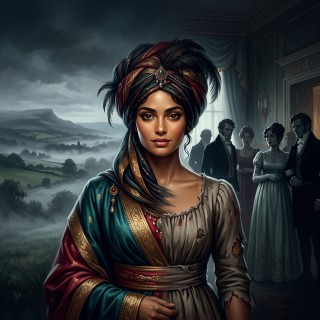
The Fake Princess of Javasu: The Spectacular Masquerade of Princess Caraboo
On an overcast evening in April 1817, a bewildering figure wandered through the quiet village of Almondsbury in Gloucestershire, England. Dressed in a patchwork of bizarre garments, wearing a makeshift black turban, and carrying a small bundle of belongings, she spoke not a word of English. When accosted by bewildered locals, she gestured toward her mouth in hunger and spoke in melodic, rhythmic gibberish that sounded entirely foreign. Unsure what to do with this apparent vagrant, the village overseer brought her to the grand country estate of Knole Park, home of the local magistrate and county squire, Samuel Worrall.
Little did the Worrall family know that they were welcoming one of the most audacious impostors in British history into their drawing room. The young woman, possessing olive-toned skin, dark lustrous hair, and striking expressive eyes, refused to answer questions posed in standard European tongues. Instead, she responded with elaborate pantomime and strange utterances like ‘Calapoo,’ ‘Tazee,’ and ‘Javasu.’ Intrigued rather than suspicious, Samuel Worrall’s American-born wife, Elizabeth, became captivated by the delicate stranger. She installed the girl in the local inn before quickly moving her into Knole Park, determined to uncover her identity.
The breakthrough came when a Portuguese sailor named Manuel Eynesso arrived in the neighborhood. Claiming an intimate familiarity with the Far East, Eynesso heard the mysterious woman speak and boldly declared that he understood her language. According to his dramatic translation, the girl was ‘Princess Caraboo’ from the distant, idyllic island kingdom of Javasu in the East Indies. Tragic royalty, she had purportedly been kidnapped from her homeland by ferocious Malayan pirates. After months of captivity across tempestuous oceans, the pirate vessel anchored off the coast of England, where Caraboo made a daring escape by leaping into the freezing waters of the Bristol Channel and swimming ashore.
The tale was pure romantic fantasy, tailored perfectly to the tastes of Regency England, an era utterly obsessed with Orientalism, exotic voyages, and Byronian heroes. For ten intoxicating weeks, high society threw itself at the feet of Princess Caraboo. The Worralls hosted lavish salons where dukes, duchesses, bishops, and scholars flocked to observe her. Caraboo played her part to perfection: she made bows and arrows from twigs and shot with pinpoint accuracy in the gardens; she fenced with walking sticks; she climbed towering trees to conduct elaborate dawn prayers to ‘Allah Tallah’; she swam in the estate’s pond and serenaded guests with rhythmic songs on a tambourine. Renowned portrait artist Nicolas Huet was commissioned to paint her likeness, capturing her regal, turbaned profile for posterity.
Yet beneath the silk draperies and exotic facade lived Mary Willcocks, the impoverished daughter of a cobbler from the rural village of Wembury, Devon. Born in 1792, Mary had lived a grueling, desperate life. Shuffled between domestic service jobs, abusive employers, and the crushing poverty of London’s workhouses, she had once fallen gravely ill and nearly starved on the streets. Mary had developed a survival mechanism: a vivid imagination, a gift for mimicry, and a fierce determination never to be subjugated again. Combining fragments of Romani dialect, stray words picked up from dockside sailors, and utter linguistic invention, she had engineered a persona so captivating that the British aristocracy surrendered their common sense to believe it.
The illusion shattered as quickly as it had formed. The sensational news of the exotic princess spread throughout the country via newspapers. In nearby Bristol, a boarding-house keeper named Mrs. Neale saw a description of Caraboo in the ‘Bristol Journal’. She recognized the exotic princess instantly: it was Mary, an eccentric former tenant who had frequently entertained her children with made-up languages, strange songs, and wild stories of foreign lands.
Confronted by a devastated Mrs. Worrall, Mary broke down and confessed her true identity. Yet, the anticipated scandal took an unexpected turn. While high society blushed with embarrassment at being so easily duped by an illiterate servant girl, the public was wildly amused. Mary had effortlessly outsmarted scholars, linguists, and aristocrats. Rather than sending her to prison for vagrancy or fraud, Elizabeth Worrall—perhaps out of affection, pity, or a desire to quietly hush the embarrassment—arranged for Mary’s passage to Philadelphia in the United States.
In America, Mary tried to capitalize on her fame, briefly staging theatrical exhibitions as Princess Caraboo, but the novelty had faded. She eventually returned to England, living quietly under her married name, Mary Baker. In an irony fitting of her bizarre life, she spent her final decades earning an honest living in Bristol as an official supplier of leeches to the Bristol Royal Infirmary. When she died in 1864, Mary left behind a legendary legacy: a masterclass in psychological manipulation that proved high society’s perceptions of nobility and exoticism were as fragile as the garments she had woven out of thin air.