No transcript available for this episode.
S01:E92
The Ghost Ship of the Atlantic: Unraveling the Mary Celeste Mystery
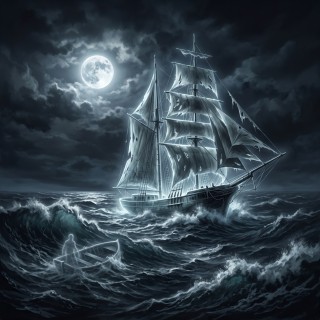
On December 4, 1872, a chilling discovery was made in the vast, unforgiving expanse of the Atlantic Ocean. The British brigantine Dei Gratia, en route from New York to Gibraltar, spotted a vessel behaving erratically some 600 miles east of the Azores. Its sails were strangely set, and its course seemed aimless. As the Dei Gratia drew closer, Captain David Morehouse recognized the ship: it was the Mary Celeste, a brig he knew well, having dined with its captain, Benjamin Briggs, just days before their departure from Staten Island. What they found upon boarding would forever etch the Mary Celeste into the annals of maritime legend and unsolved mysteries.
The scene was one of profound eeriness. The Mary Celeste was, to all appearances, perfectly seaworthy. Her cargo of 1,701 barrels of denatured alcohol – a highly flammable and valuable commodity – was intact and undisturbed. The ship’s logbook was found, its last entry dated November 25, indicating their position was 100 miles west of the Azores. A sewing machine sat on a table in the captain’s cabin, a child’s toys lay scattered, and half-eaten meals suggested a hasty departure. Yet, not a single soul was aboard. Captain Briggs, his wife Sarah, their two-year-old daughter Sophia, and the seven-man crew had vanished without a trace.
The initial investigation by the Admiralty Court in Gibraltar was thorough but ultimately inconclusive. Judge Sir James Cochrane, overseeing the salvage hearing, was initially suspicious of foul play, even suggesting the crew of the Dei Gratia might have murdered the Mary Celeste’s crew for salvage rights. However, a meticulous examination of the ship revealed no signs of violence or struggle. The ship’s chronometer and sextant were missing, as was the life raft, leading to the most plausible early theory: the crew had abandoned ship in a panic, possibly due to a perceived threat, and the life raft had subsequently been lost at sea. But what could have caused such a seasoned captain as Benjamin Briggs to abandon a perfectly sound vessel?
Over the decades, countless theories have been proposed, each more speculative than the last. One popular theory centers on the cargo itself. The denatured alcohol, being highly volatile, might have emitted noxious fumes or even caused a small explosion, scaring the crew into the life raft. A slightly damaged pump and a missing depth sounding device lent some credence to the idea that the ship might have taken on water, leading Briggs to believe it was sinking. However, the subsequent discovery of the ship in perfect condition contradicts the idea of a catastrophic leak.
Piracy was another early contender, but the undisturbed cargo and lack of any signs of struggle or plunder make this unlikely. Mutiny, a dramatic and often romanticized explanation, also lacks any supporting evidence. The crew, though international, was generally considered reliable.
More exotic theories have emerged over time. A waterspout, a powerful column of rotating air and water, could have struck the ship, momentarily disorienting the crew and causing them to believe the ship was in peril. However, a waterspout would likely have left more significant damage. Sea monsters, alien abductions, and even a rogue wave have been put forward, each highlighting the sheer baffling nature of the disappearance.
The enduring mystery of the Mary Celeste lies in its utter lack of explanation. There were no distress signals, no bodies, and no discernible reason for abandonment. The ship itself, a silent sentinel adrift, held the secrets of its missing crew. It became a canvas upon which humanity projected its deepest fears of the unknown, of the sea’s power to consume without a trace. The Mary Celeste remains the quintessential ghost ship, a haunting reminder that some enigmas are destined to defy resolution, forever sailing in the realm of conjecture and speculation.