S01:E09
The Giza Megaproject: How the Ancients Built the Great Pyramid of Khufu
For over forty-five centuries, a monumental titan of stone has stood watch over the shifting sands of the Giza Plateau. The Great Pyramid of Giza, built for the Pharaoh Khufu (known in Greek as Cheops), is not merely an ancient tomb; it is an absolute marvel of human engineering, a testament to organizational genius, and the only surviving wonder of the ancient world. For millennia, it was the tallest man-made structure on Earth, a title it held for over 3,800 years. But how did a Bronze Age civilization, lacking iron tools, the wheel, and modern pulleys, construct a monument of such staggering scale and mathematical precision? To understand this feat, we must journey back to 2560 BCE, into a world of unmatched ambition.
At the heart of this colossal undertaking was Hemiunu, Khufu’s vizier and the mastermind behind the project. Hemiunu faced an unprecedented logistical challenge. His task was to quarry, transport, and precisely place approximately 2.3 million stone blocks, weighing an average of 2.5 tons each, with some massive granite beams in the King’s Chamber weighing up to 80 tons. The sheer scale of materials required a highly synchronized supply chain. Limestone was quarried locally at Giza for the core, while high-quality white limestone for the outer casing was ferried across the Nile from Tura. The giant granite blocks, used to safeguard the pharaoh’s final resting place, had to be transported on massive wooden barges down the Nile from Aswan—a journey of over 800 kilometers.
For decades, popular culture maintained the myth that the pyramids were built by thousands of brutalized slaves. Modern archaeology has shattered this illusion. Excavations of the builders’ town at Giza have revealed that the workforce was actually a highly organized army of skilled conscripts and permanent artisans. These workers were well-fed, receiving rations of meat, bread, and beer, and they received high-quality medical care. It is estimated that a workforce of around 20,000 to 30,000 men worked in rotating shifts. They were divided into competitive units called ‘phyles’ with names like ‘Friends of Khufu,’ fostering a sense of pride and camaraderie in their monumental task.
Perhaps the most mind-boggling aspect of the Great Pyramid is its astronomical and mathematical precision. The pyramid’s base is aligned to the four cardinal directions—North, South, East, and West—with an error of less than one-fifteenth of a single degree. How did they achieve this? Archaeologists believe the builders utilized the stars, possibly tracking the rotation of two circumpolar stars to find true north. Furthermore, the ratio of the pyramid’s perimeter to its height closely approximates the mathematical constant Pi (2π), a concept supposedly discovered centuries later.
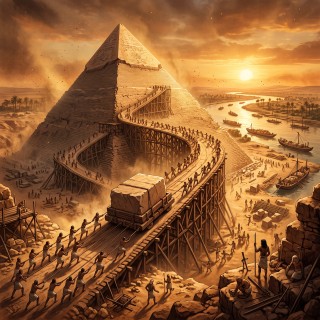
But the ultimate question remains: How did they lift these multi-ton blocks to a height of 146 meters? While no written records survive detailing the exact method, the leading scientific theories point to an ingenious system of ramps. Some scholars propose a straight, external ramp that grew as the pyramid rose, though this would have required more material than the pyramid itself. Others suggest a zig-zagging ramp, or a spiral ramp wrapping around the exterior. A compelling modern theory by French architect Jean-Pierre Houdin suggests a combination of a straight external ramp for the lower half and an internal, spiraling tunnel-ramp to complete the upper section. To ease the friction of pulling the heavy sledges over the sand, workers likely poured water in front of the wooden runners, cutting the required pulling force in half.
When completed, the Great Pyramid looked vastly different than it does today. It was encased in polished, gleaming Tura limestone that reflected the desert sun like a brilliant mirror, topped with a golden pyramidion (capstone). It was a beacon of light visible for miles, symbolizing the pharaoh’s divine connection to the sun god, Ra. Today, though stripped of its outer casing and worn by the relentless march of time, the Great Pyramid of Khufu remains a breathtaking testament to what humanity can achieve when driven by shared purpose, sheer determination, and unmatched ingenuity.