S01:E67
The Gold Nugget That Stopped a Wagon: The Discovery of the ‘Welcome Stranger’
On a scorching summer morning on February 5, 1869, in the dry, dust-choked scrub of Moliagul, Victoria, two Cornish prospectors were on the brink of surrender. John Deason and Richard Oates had spent years chasing fortune in the unforgiving Australian goldfields. Like thousands before them, they had crossed oceans fueled by whispered legends of untold wealth beneath the red earth. Instead, they had found blistering heat, flies, backbreaking toil, and barely enough gold dust to pay for flour, tea, and tobacco. Moliagul was practically played out, its red gullies gouged and picked over by waves of desperate diggers who had moved on to greener pastures. Yet Deason and Oates lingered, scratching at Bulldog Gully with stubborn persistence.
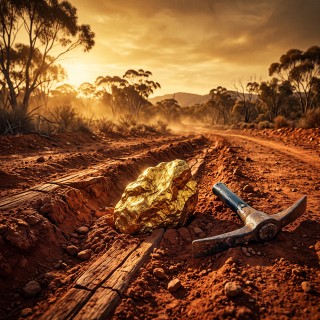
That Friday morning, Deason was working near the roots of a gnarled stringybark eucalyptus tree. A rough bush track cut across the dusty slope—a primitive road carved out by heavy bullock drays and wooden wagons ferrying supplies to forgotten camps. As Deason swung his pick into the hard-packed earth mere inches from the rutted track, the steel tip struck something dense and unyielding. The shock vibrated painfully up his arms, snapping the point off his pick.
Cursing the stubborn quartz or ironstone that had ruined his tool, Deason knelt to clear away the gravel. He expected to find a typical boulder of worthless ironstone, a nuisance common to the Victoria goldfields. Instead, brushing away a bare inch of dry topsoil, his calloused fingers grazed something smooth, heavy, and unmistakably cold. He scraped harder with a pocketknife, clearing a rim of red clay. Beneath the dust gleamed a patch of dull, unmistakable buttery yellow.
Deason’s heart hammered against his ribs. He probed further, expecting the golden vein to vanish into a matrix of quartz. But the yellow surface kept expanding. It was not a thin skin or a localized flake; it was a solid, monumental slab of near-pure gold, resting practically on the surface where wagon wheels had rolled over it for years without anyone suspecting the fortune lurking beneath.
Struggling to maintain his composure, Deason hailed Oates, who was working a windlass a short distance away. When Oates ambled over, Deason simply pointed down into the shallow depression. The men stared in breathless disbelief. Together, using crowbars and picks, they gingerly pried the behemoth from its ancient bed. When it finally broke free of the earth with a wet, heavy thud, it took both men straining with all their might just to lift it. They had unearthed the largest alluvial gold nugget the world had ever seen: a monster measuring over two feet in length and weighing over 210 pounds.
Panic immediately replaced exhilaration. Bushrangers and claim jumpers roamed the Victorian bush, and word of such a discovery would ignite a violent frenzy. The two miners concealed the golden titan under brush and dirt, waiting in agonizing suspense until nightfall. Under the cover of darkness, they wrestled the boulder onto a sturdy dray, covered it with sacking, and wheeled it back to Deason’s modest hut. There, behind bolted wooden doors, they built a roaring fire in the hearth to roast the stone, burning away the clinging quartz, mud, and debris until only pure, glistening gold remained.
The following Monday, flanked by a handful of trusted, heavily armed companions, Deason and Oates loaded the stone into a wagon and made the tense trek to the London Chartered Bank in the neighboring town of Dunolly. When bank manager George Foord laid eyes on the monolith, he could scarcely believe his senses. The bank’s official scales were designed for standard parcels of dust and small nuggets; the sheer mass of this golden giant threatened to crush the delicate balance.
Unable to weigh it in one piece, the banker was forced to recruit a local blacksmith, Archibald Walls, who attacked the colossal nugget with a cold chisel and a sledgehammer. It required brutal effort to cleave the prize into manageable chunks. Even after breaking off pieces for souvenirs and trimming, the net gold content yielded an astonishing 2,284 ounces—nearly 71 kilograms of pure gold. The bank paid Deason and Oates £9,583 on the spot, an astronomical fortune in 1869, equivalent to millions of dollars today.
Christened the ‘Welcome Stranger’, this freak of geological history had lain hidden for millions of years, escaping countless prospectors by a mere inch of red dust. It instantly entered legend, immortalizing the two impoverished Cornish miners and cementing Victoria’s reputation as the richest gold-bearing territory on the planet.