The Great Train Robbery: Midnight, Money, and the Crime of the Century
In the pitch-black early hours of August 8, 1963, the quiet countryside of Buckinghamshire, England, became the stage for one of the most daring, meticulous, and notorious crimes in modern history. The target was the Royal Mail Travelling Post Office train traveling from Glasgow to London Euston. Packed inside its high-value package carriage were millions of pounds in used banknotes, returning to headquarters after a Bank Holiday weekend. What unfolded that night would become known globally as ‘The Great Train Robbery.’
The mastermind behind this audacious plot was Bruce Reynolds, an antiques dealer and career criminal who assembled a top-tier crew known informally as ‘The Firm.’ Reynolds spent months planning the heist with military precision. The operation required deep inside knowledge of railway operations, signal mechanics, and extreme discipline. The gang knew that to pull off the ultimate score, they couldn’t just use brute force; they had to outsmart the system.
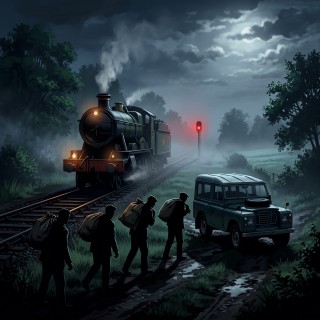
At roughly 3:00 AM, near Sears Crossing, the robbers put their ingenious plan into motion. The train driver, 57-year-old Jack Mills, noticed a glowing red signal light ahead. Unbeknownst to him, the gang had covered the green signal light with a leather glove and connected a six-volt battery to power the red light manually. Tricked into stopping the massive locomotive in the isolated dark, Mills stepped down to investigate.
Before he could comprehend what was happening, shadowed figures burst from the darkness. A violent struggle ensued, during which Jack Mills was struck over the head with an iron bar—a brutal blow that would haunt the crime’s legacy forever. The gang quickly overwhelmed the remaining crew, detached the engine and the first two carriages containing the cash, and forced the dazed driver to move the train a half-mile further down the track to Bridego Bridge.
At Bridego Bridge, a waiting human chain was formed. In just under 45 minutes, fifteen men unloaded 120 sacks containing approximately 2.6 million pounds—equivalent to over 50 million pounds today. The cash was transferred into a waiting truck, a Land Rover, and an Austin van. The haul was stupendous, completely eclipsing any heist Britain had ever witnessed.
The gang retreated to their secret hideout, Leatherslade Farm, situated about 27 miles from the crime scene. There, isolated from the world, they celebrated their success in surreal fashion: drinking beer and playing the board game Monopoly using genuine, stolen bank notes. They intended to lay low for several weeks until the initial police manhunt cooled down.
However, panic soon set in. News broke that Scotland Yard was scouring every property within a 30-mile radius. Terrified of being trapped, the robbers panicked and fled the farm early, paying an associate to clean the hideout and burn it to the ground. Crucially, the hired cleaner failed to complete the job.
When police discovered Leatherslade Farm a few days later, it was a goldmine of evidence. Fingerprints were everywhere—on ketchup bottles, beer cans, and most famously, on the Monopoly board itself. Scotland Yard’s elite Flying Squad, led by the relentless Detective Chief Superintendent Tommy Butler, moved with lightning speed. Within months, most key members of the gang, including Bruce Reynolds, Buster Edwards, and Charlie Wilson, were behind bars.
In 1964, heavy sentences were handed down; the ringleaders received stunning 30-year prison terms to send a stern message to the underworld. Yet the story did not end in the courtroom. Bold escapes, most notably by Ronnie Biggs, who scaled the walls of Wandsworth Prison and spent decades living as a fugitive in Brazil, transformed the robbers into romanticized folk legends in the eyes of the tabloid press.
Despite the glamorous myth constructed by popular culture, the Great Train Robbery left a dark trail. Jack Mills never fully recovered from his injuries and died seven years later. The crime reshaped British law enforcement, revolutionized postal security, and proved that while money can buy temporarily freedom, the long arm of the law eventually catches up.