No transcript available for this episode.
S01:E100
The Green Children of Woolpit: An Enduring Medieval Mystery
In the annals of medieval English folklore, few tales are as captivating and utterly perplexing as that of the Green Children of Woolpit. This extraordinary chronicle, documented by two chroniclers, William of Newburgh and Ralph of Coggeshall, in the latter half of the 12th century, presents a bewildering account of two children who materialised seemingly from thin air, possessing not only an unfamiliar language but also an astonishing verdant hue to their skin. It’s a story that has baffled historians, folklorists, and scientists for centuries, defying easy explanation and continuing to spark fervent debate.
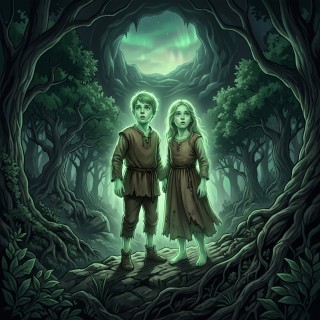
The year was approximately 1150 (though some accounts suggest slightly earlier), during the reign of King Stephen. The village of Woolpit, in Suffolk, England, was a humble agricultural community. One day, the villagers were astounded to discover two small children – a boy and a girl – near one of the wolf-pits from which the village derived its name. What immediately struck them, beyond their evident distress and unfamiliar attire, was the colour of their skin: a distinct, vibrant green. They spoke a language no one understood, and initially refused all food offered to them. They seemed disoriented, terrified, and utterly alien.
They were eventually taken in by Sir Richard de Caine, a prominent local landowner, who provided them with shelter and sustenance. For a period, they ate nothing but raw broad beans, which they discovered by accident, having rejected all other foodstuffs. Gradually, their green colour began to fade, particularly that of the boy. Sadly, the boy, who was reportedly the younger of the two, fell ill and died not long after their appearance, before he could learn English or shed much light on their origins.
The girl, however, thrived. As she adapted to her new environment, her skin colour fully returned to normal, and she eventually learned to speak English. It was through her testimony, albeit recounted years later and possibly embellished, that some fragments of their bizarre story emerged. She claimed they came from a place she called ‘St. Martin’s Land,’ a subterranean world where the sun never shone brightly, and everything existed in a perpetual twilight. The inhabitants, she said, were green, just as they had been. She spoke of a great river that separated their land from another luminous country. She and her brother, she explained, had been tending their father’s flocks when they heard a great noise, perhaps bells, and followed it into a cave. They wandered through a long, dark passage until they emerged into the brilliant sunlight of Woolpit, bewildered and disoriented.
Historians and scholars have proposed numerous theories to explain this extraordinary event. Some suggest a purely fantastical origin, arguing the tale is a medieval folk story, perhaps an allegory or a cautionary fable, which became enshrined as historical fact. The ‘green skin’ could be a symbolic representation of foreignness or otherworldliness. Others look for more prosaic explanations. Could the children have been Flemings, persecuted immigrants who had fled into the forests, suffering from a severe nutritional deficiency (like chlorosis, or ‘green sickness,’ caused by iron deficiency, which can give the skin a greenish pallor)? This would explain their initial confusion and their unfamiliar language, which might have been Flemish, mistaken for an unknown tongue by rural English villagers.
The ‘St. Martin’s Land’ could be a metaphor for a dark forest or a secluded, remote community. The ‘subterranean’ aspect could refer to a deep valley or even a mine. The sudden emergence into daylight from a ‘cave’ could be interpreted as a child’s confused memory of escaping a dark, enclosed space. The focus on broad beans might indicate a specific dietary habit or deprivation.
However, these rational explanations, while plausible, struggle to fully account for all aspects of the narrative, particularly the vivid green skin as a universal trait of their people, and the description of a perpetually dim land. The precision with which the chroniclers recorded the event, often noting their initial skepticism and the subsequent corroboration by others, lends a certain weight to the veracity of at least some elements of the tale.
The Green Children of Woolpit remain one of history’s most tantalising cold cases. A testament to the mysteries that lie just beyond the veil of our understanding, their story continues to challenge our perceptions of reality, leaving us to ponder: were they travellers from another dimension, victims of a strange medical condition, or simply the poetic invention of a distant age? Whatever the truth, their legend endures, a vibrant green thread woven into the fabric of English history, perpetually inviting us to wonder and to question the boundaries of the known world.