S01:E24
The Gunpowder Plot: Shadows, Spark, and Treason in 1605
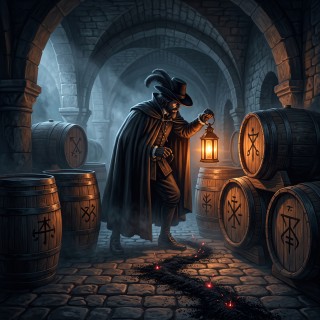
In the damp, chilly darkness of early November 1605, beneath the towering stone halls of the Palace of Westminster, a lone figure stood watch over thirty-six heavy wooden barrels. The air was thick with the scent of stagnant water, decaying wood, and sulfur. Wrapped in a dark cloak, his eyes darting at every creak of the floorboards above, was Guy Fawkes. He held a lantern in one hand and a slow-burning match in the other. Just meters above his head sat the chamber where King James I, the royal family, and the entire political elite of England were scheduled to gather the very next morning. Had Fawkes struck his match, he would have ignited over two tons of black powder—an explosion massive enough to reduce the cradle of English power to dust and change the course of world history forever.
To understand how England arrived at the precipice of such catastrophic destruction, one must look back to the simmering religious warfare of the era. Following the Protestant Reformation and the reign of Queen Elizabeth I, English Catholics found themselves systematically marginalized, fined, and persecuted. When King James VI of Scotland ascended to the English throne as James I in 1603, many Catholics dared to hope for a new era of religious tolerance. However, these hopes were swiftly shattered when the new monarch enforced even stricter anti-Catholic laws, banishing priests and levying crushing fines on those who refused to attend Anglican services.
Despair quickly turned into radicalism. Enter Robert Catesby, a charismatic, fiercely devoted Catholic gentleman whose father had been imprisoned for his faith. Catesby realized that peaceful petitions would yield nothing. What was needed, he argued, was a blow so swift and decisive that it would completely obliterate the Protestant government in a single second. Catesby assembled a tight-knit circle of co-conspirators, including Thomas Wintour, Thomas Percy, John Wright, and a battle-hardened military mercenary named Guy Fawkes, who possessed crucial expertise in explosives.
Their plan was breathtaking in its audacity. The conspirators managed to lease a basement vault directly beneath the House of Lords. Over several months, under the cover of night, they smuggled thirty-six barrels containing roughly 2,500 kilograms of gunpowder into the cellar, concealing the deadly cargo beneath stacks of firewood and coal. The date for the catastrophe was set for November 5, 1605—the State Opening of Parliament. The conspirators intended to trigger the blast, capture the King’s young daughter Princess Elizabeth in the ensuing chaos, and place her on the throne as a puppet Catholic monarch.
However, a plot involving so many moving parts ultimately fell victim to human conscience and betrayal. On October 26, Lord Monteagle, a Catholic nobleman, received an anonymous letter warning him to avoid the opening of Parliament. The letter urged him to ‘retire yourself into your country’ because ‘they shall receive a terrible blow this Parliament.’ Troubled by the cryptic message, Monteagle immediately passed it to Robert Cecil, the King’s chief minister and spymaster.
Cecil played a cunning game, waiting until the last possible moment to strike. Shortly before midnight on November 4, royal guards led by Sir Thomas Knyvet raided the vaults beneath Parliament. There, in the shadow-draped cellar, they caught Guy Fawkes red-handed, wearing boots and spurs, carrying a pocket watch, and holding fuse matches. The barrels of gunpowder were uncovered, exposing the horrifying scope of the treason.
Fawkes was dragged to the Tower of London. Under the explicit orders of King James I, he was subjected to brutal torture, including the rack. For days, Fawkes maintained defiance, giving a fake name, but the unbearable agony eventually broke his spirit. He signed a confession, his signature a trembling, barely legible scrawl, revealing the names of his co-conspirators.
When news of the plot’s collapse spread, Catesby and his remaining followers fled London toward the Midlands, desperately hoping to ignite a Catholic rebellion. But no uprising materialized. Royal troops surrounded them at Holbeche House in Staffordshire. In a dramatic final stand, Catesby and Percy were shot dead by a single musket ball. The surviving plotters were captured, dragged back to London, and sentenced to the horrific fate reserved for traitors: to be hanged, drawn, and quartered.
The Gunpowder Plot left a permanent mark on the British psyche. In the immediate aftermath, Parliament declared November 5th a national day of thanksgiving. To this day, across the United Kingdom, ‘Guy Fawkes Night’ or ‘Bonfire Night’ is marked with fireworks and the burning of effigies on roaring bonfires, echoing the famous rhyme: ‘Remember, remember! The fifth of November, the Gunpowder treason and plot.’