0:00Intro
The Honking Heroes: How Geese Saved Rome from Gallic Fury
The year is 390 BC. Rome, a burgeoning power in the Italian peninsula, found itself facing its most existential threat to date. A fierce Gallic tribe, the Senones, led by the formidable Brennus, had swept down from the north, crushing Roman legions at the Battle of the Allia. The city itself was sacked, its streets running red with blood, its temples defiled, and its citizens fleeing in terror. All that remained of Roman defiance was a small, desperate band of patricians, soldiers, and citizens holed up on the Capitoline Hill, the sacred heart of Rome, awaiting their inevitable fate.
The siege was long and brutal. Food supplies dwindled, morale wavered, and the Gauls, frustrated by their inability to breach the formidable natural defenses of the Capitol, began to grow impatient. They attempted a surprise night assault, a treacherous climb up the steepest, most unguarded part of the cliff face, believing the Romans would be deep in slumber, lulled into a false sense of security by the perceived impregnability of their fortress. Moonlight, or perhaps more accurately, the lack thereof, was their accomplice, cloaking their ascent in shadow.
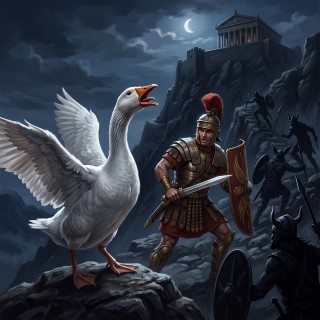
Yet, unknown to the Gauls, and perhaps even to the Romans themselves, an unlikely guardian stood watch. Within the temple of Juno, the queen of the gods, a flock of sacred geese was kept. These weren’t just any geese; they were considered particularly holy, consecrated to the goddess, and were thus spared from the widespread hunger plaguing the besieged Romans. Their constant honking and squawking were usually dismissed as background noise, an irritating but harmless presence. On this particular night, however, their usual chatter would become the clarion call of salvation.
As the first Gallic soldier, emboldened by the silent night and the apparent lack of sentries, began to crest the summit, a sudden, cacophonous outburst erupted. The sacred geese, disturbed by the unfamiliar movements and the subtle rustling in the pre-dawn darkness, began to cackle, honk, and flap their wings with frantic intensity. Their piercing cries, amplified by the stillness of the night, shattered the silence, echoing across the Capitoline Hill.
The sleeping Roman guards, startled from their slumber by the unexpected and insistent clamor, immediately sprang to action. Marcus Manlius Capitolinus, a former consul and a renowned military hero, was among the first to react. Grabbing his sword and shield, he rushed to the nearest parapet, peering into the gloom. What he saw sent a jolt of ice through his veins: Gallic warriors, their shadowy forms just emerging over the crest, their weapons glinting faintly in the nascent light. They were just moments away from securing a foothold inside the last bastion of Rome.
Manlius, with a roar that reverberated across the hill, engaged the first Gaul, sending him tumbling headlong down the precipice. His courageous stand galvanized the other awakened Romans. The element of surprise, which had been the Gauls’ greatest asset, was completely lost. Disoriented by the sudden alarm and facing a now alert and desperate defense, the Gauls found themselves at a severe disadvantage. The narrow, treacherous ascent that had aided their stealth now became a death trap. Romans hurled rocks, javelins, and bodies down upon them. The Gauls, unable to form ranks or effectively counterattack in the confined and steep terrain, were repelled with heavy losses.
The assault was foiled. Rome had been saved, not by the prowess of its legions – for they were shattered – but by the vigilant honking of a flock of sacred geese. This legendary incident, recounted by Roman historians like Livy, quickly became etched into the Roman psyche. It served as a powerful reminder that even in the darkest hours, salvation can come from the most unexpected of sources. The geese were thereafter held in even greater reverence, and the story of their heroism became a cornerstone of Roman lore, a testament to vigilance, courage, and perhaps, a touch of divine intervention. It’s a tale that continues to fascinate, a testament to how the humble honk of a bird could change the course of history and ensure the survival of one of the greatest empires the world has ever known.