0:00Intro
The Iron Peony: How Wu Zetian Conquered the Dragon Throne
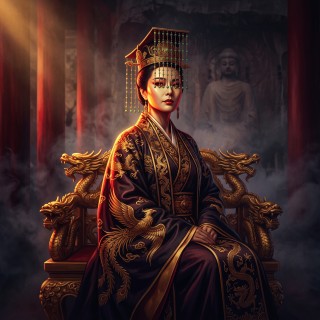
In the gilded cages of seventh-century Chang’an, women were expected to be soft, compliant, and invisible in the annals of statecraft. Confucian doctrine dictated that a woman ruling China was as unnatural as a hen crowing at dawn—an omen of cosmic catastrophe and dynastic collapse. Yet, shattering millennia of patriarchal dogma, one woman engineered an ascent so audacious, calculated, and brilliant that she seized the Mandate of Heaven for herself. Her name was Wu Zhao, known to history as Wu Zetian: the first, and only, female Emperor of China.
Her story began not in the corridors of power, but in the shaded chambers of the imperial harem. Born into a wealthy noble family where she was unusually encouraged to read, write, and study statecraft, fourteen-year-old Wu was summoned to the court of Emperor Taizong in 637 CE. Entering as a lowly fifth-rank concubine titled ‘Talent’ (Cairen), she was merely one of hundreds of decorative consorts. Taizong appreciated her wit and courage—famously demonstrated when she offered to tame an unruly imperial stallion with an iron whip, an iron hammer, and a dagger—but she failed to capture his heart or bear him an heir.
When Taizong died in 649 CE, custom dictated a grim fate for his childless concubines: their heads were shaved, and they were exiled to the cold, cloistered silence of Ganye Buddhist convent to spend their remaining days in prayer. To ordinary women, this was a living death sentence. To Wu, it was merely an inconvenient intermission. Before Taizong had passed, Wu had begun a dangerous, clandestine flirtation with his son, the gentle and sickly Crown Prince Li Zhi, who ascended the throne as Emperor Gaozong.
Besotted by memories of her, Gaozong visited the convent. In a stroke of miraculous fortune engineered by court intrigue, Gaozong’s barren wife, Empress Wang, invited Wu back to the imperial palace. Empress Wang mistakenly believed Wu could serve as an ally to distract the Emperor from a rival favorite, Consort Xiao. It was a fatal miscalculation. Once back within the palace walls, Wu systematically neutralized all competition. In an incident shadowed by infamy, Wu’s newborn infant daughter died suddenly; Wu tearfully accused Empress Wang of strangling the baby out of jealousy. While modern historians still debate whether the child died of natural causes or by Wu’s own ruthless hand, the result was absolute. In 655 CE, Empress Wang and Consort Xiao were arrested, mutilated, and executed. Wu Zetian was crowned Empress Consort.
Her partner on the throne, Gaozong, soon suffered a series of devastating, paralytic strokes that impaired his vision and cognitive energy. Stepping out from behind the veil, Wu became the de facto ruler of the Tang Empire. Seated beside her husband as one of the ‘Two Sages,’ she dictated decrees, received ambassadors, and governed with cold efficiency. She surrounded herself with a web of secret informants and established an infamous secret police force led by ruthless inquisitors like Lai Junchen, crushing aristocratic opposition before treason could even be whispered.
When Gaozong died in 683 CE, Wu wasted no time. When her eldest surviving son, Emperor Zhongzong, showed signs of defiance, she deposed and exiled him within six weeks, replacing him with his younger, more malleable brother, Ruizong. But acting as the power behind a puppet was no longer enough. In 690 CE, after orchestrating a nationwide wave of petitions that ‘begged’ her to assume the throne, Wu pushed her son aside, proclaimed the new Zhou Dynasty, and declared herself Huangdi—the absolute, sovereign Emperor. She invented new written characters, including ‘Zhao’ (representing the sun and moon hanging in the heavens), to immortalize her divine right.
Contrary to Confucian propaganda that painted her reign as a blood-soaked nightmare, Wu Zetian proved to be an exceptionally competent and visionary monarch. Recognizing that entrenched aristocratic clans threatened her supremacy, she radically reformed the imperial examinations, opening governance to scholars from humble backgrounds based strictly on merit rather than bloodline. She lowered agricultural taxes, patronized arts and literature, secured the Silk Road, and promoted Buddhism above Daoism, commissioning monumental masterpieces like the colossal Vairocana Buddha at the Longmen Grottoes, carved in her very likeness.
For fifteen years, Wu ruled unchallenged. Only in 705 CE, when illness gripped her at the age of eighty-one, did a palace coup force her abdication in favor of her son, restoring the Tang Dynasty. Months later, she passed away quietly. She was interred alongside Gaozong at the Qianling Mausoleum, where an immense, monolithic stone monument—the Wordless Stele—was erected to mark her resting place. Defying tradition, she ordered that not a single word be carved onto the stone, leaving posterity, in all its bias and wonder, to judge her extraordinary reign for itself.