S01:E43
The Jewel in the Crown: The Epic Saga of India’s Colonization
Long before European ships dropped anchor along the Malabar Coast, India was legendary across the globe as a land of unimaginable wealth, exquisite textiles, fragrant spices, and priceless gemstones. In the 17th century, the Indian subcontinent produced nearly a quarter of the world’s economic output under the grand reign of the Mughal Empire. It was this irresistible economic brilliance that drew rival European maritime powers—the Portuguese, Dutch, French, and British—into a ferocious struggle for commercial supremacy in Asia. However, what began as a modest quest for pepper, silk, and calico would ultimately evolve into one of the most extraordinary and devastating geopolitical transformations in human history: the subjugation of an entire continent by a single corporate entity.
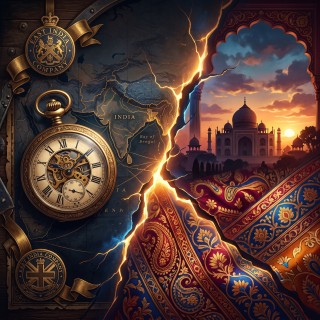
On New Year’s Eve in 1600, Queen Elizabeth I granted a royal charter to a group of London merchants, establishing the Governor and Company of Merchants of London Trading into the East Indies—famously known as the East India Company (EIC). Unlike classical empires established by imperial monarchs, the EIC was a private, joint-stock corporation driven strictly by profit margins and shareholder returns. Armed with its own private army composed largely of native Indian soldiers known as sepoys, the Company subtly maneuvered through the complex political landscape of a declining Mughal Empire. Through strategic diplomacy, mercenary military force, and financial bribes, the Company steadily expanded its coastal trade outposts into formidable territorial footholds.
The decisive turning point occurred in 1757 at the Battle of Plassey in Bengal. Led by the ambitious and ruthless Robert Clive, Company forces defeated the Nawab of Bengal through a combination of tactical military discipline and covert treachery, bribing the Nawab’s chief commander, Mir Jafar. In the wake of this victory, the EIC secured the Diwani—the legal right to collect land revenue—over the fabulously wealthy province of Bengal. Overnight, a foreign commercial enterprise became the sovereign ruler and tax collector of tens of millions of people. The staggering wealth extracted from Bengal was funneled directly into expanding the Company’s private military, paving the way for the systematic conquest of the rest of the subcontinent.
To consolidate its grasp over a vast territory populated by diverse languages, cultures, and kingdoms, the British perfected the art of “divide and rule.” They systematically exploited regional rivalries, offering military treaties known as “subsidiary alliances” to local princes. These agreements offered British military protection in exchange for exorbitant payments and political concessions, effectively stripping Indian rulers of their independence while forcing them into catastrophic debt. Simultaneously, British economic policies dismantled India’s world-leading textile manufacturing sector. India was intentionally transformed from a major exporter of finished goods into a captive importer of British manufactured items and a supplier of raw materials such as raw cotton, opium, indigo, and tea.
Decades of political disenfranchisement, economic drain, and cultural humiliation boiled over in 1857 in what became known as the Sepoy Mutiny, or the First War of Indian Independence. The immediate spark was the introduction of the Enfield rifle, which required soldiers to bite open cartridges rumored to be greased with beef and pork fat—an act offensive to both Hindu and Muslim sepoys. However, the true causes ran much deeper, rooted in widespread anger against land annexations and colonial tyranny. The rebellion engulfed vast swaths of northern and central India in violent conflict. Although Indian fighters displayed remarkable bravery, the uprising was ultimately crushed by British forces with merciless brutality.
The shockwaves of 1857 forced the British Parliament to abolish the East India Company entirely. In 1858, governance was transferred directly to the British Crown, establishing the era of the British Raj. Queen Victoria was formally proclaimed Empress of India in 1877. The Raj constructed extensive infrastructure across the nation, including thousands of miles of railways, telegraph lines, and modern postal systems. Yet, these engineering marvels were designed primarily to facilitate troop movements and accelerate the export of Indian resources to Britain. During this period, catastrophic famines repeatedly struck the subcontinent, killing tens of millions of people, even as food grains continued to be exported overseas to satisfy imperial trade markets.
Out of the crucible of colonial oppression, a unified Indian national consciousness began to take shape. Founded in 1885, the Indian National Congress evolved from a modest elite assembly into a mass movement for self-determination. In the 20th century, Mohandas Karamchand Gandhi transformed the struggle through the revolutionary philosophy of Satyagraha—mass non-violent civil disobedience. Alongside visionary leaders like Jawaharlal Nehru, Sardar Patel, Subhas Chandra Bose, and revolutionists like Bhagat Singh, the movement mobilized millions against foreign domination.
Exhausted by the immense strain of World War II and facing insurmountable resistance across South Asia, Great Britain finally made the decision to withdraw in 1947. However, the exit was rushed and deeply flawed. The hurried drawing of borders by Sir Cyril Radcliffe sliced the subcontinent along religious lines into two new sovereign states: India and Pakistan. The resulting Partition unleashed mass panic, tragic communal violence, and the displacement of over 14 million people, alongside an estimated one to two million deaths. On August 15, 1947, India finally raised its tricolor flag as an independent nation, closing a complex, turbulent chapter of imperial rule that irrevocably reshaped the modern world.