
0:00Intro
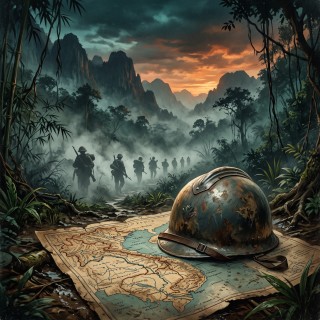
The Jungle of Shadows: How a Peasant Army Shattered an Empire
The year was 1945. The ashes of World War II were still smoldering across Europe and Asia, but in the dense, mist-shrouded jungles of Southeast Asia, a new and devastating storm was brewing. France, eager to reclaim its pre-war prestige and imperial glory, sought to re-establish control over its jewel colony: French Indochina, comprising Vietnam, Laos, and Cambodia. But the world had changed. A fierce spirit of nationalism had awakened, personified by a thin, enigmatic leader named Ho Chi Minh. On September 2, 1945, standing before a cheering crowd in Hanoi, Ho Chi Minh declared the independence of the Democratic Republic of Vietnam. The stage was set for a classic David versus Goliath clash—the First Indochina War.
At first glance, the contest seemed utterly lopsided. The French Far East Expeditionary Corps was a formidable military machine. Backed by elite paratroopers, seasoned French Foreign Legionnaires, heavy armor, and air superiority, the French expected a swift victory against what they dismissed as a ragtag band of rebels. But the Viet Minh—the nationalist coalition led by Ho Chi Minh—had a secret weapon: General Vo Nguyen Giap. A self-taught military genius, Giap understood that conventional warfare would mean suicide. Instead, he initiated a brutal, patient war of attrition.
The Viet Minh vanished into the shadows of the triple-canopy rainforests. They turned the unforgiving terrain into an ally. By day, they were invisible peasants working the rice paddies; by night, they were lethal guerrillas. They struck isolated French outposts, severed supply lines, and dissolved back into the wilderness before the French could bring their heavy artillery to bear. As the years dragged on, the French treasury bled dry, and public support in Paris began to fracture. The war was dubbed ‘la sale guerre’—the dirty war.
By 1949, the geopolitical landscape shifted dramatically. The communist victory in China provided the Viet Minh with a massive, friendly neighbor that supplied modern weapons, training, and sanctuaries. Terrified of the ‘Domino Theory’—the idea that if Vietnam fell to communism, the rest of Asia would follow—the United States stepped in, heavily bankrolling the French war effort. By 1954, America was paying for nearly eighty percent of the French military budget in Indochina. Yet, money could not buy victory in the jungle.
Desperate to force the Viet Minh into a decisive, open battle where superior French firepower could crush them, French commander Henri Navarre devised a bold, high-stakes plan. He established a massive, heavily fortified air-land base in a remote valley in northwestern Vietnam, near the Laotian border. The place was called Dien Bien Phu. Navarre believed that the Viet Minh would never be able to bring heavy artillery through the trackless, mountainous jungle surrounding the valley. It was a fatal miscalculation.
General Giap saw the French trap and decided to spring one of his own. In an astonishing feat of human endurance, tens of thousands of Viet Minh soldiers and civilian conscripts dragged heavy artillery pieces by hand over sheer mountain passes, camouflaging them with branches to hide them from French aircraft. They dug miles of trenches, gradually encircling the valley.
On March 13, 1954, the trap snapped shut. The hills around Dien Bien Phu erupted in a thunderous roar. Rain of steel poured down on the stunned French garrison. The airstrip was quickly destroyed, cutting off French reinforcement and evacuation. For fifty-seven agonizing days, the battle raged in knee-deep mud and blood. It was a hellish, modern siege. On May 7, 1954, the French white flag went up over the command bunker. Over ten thousand French troops surrendered.
The fall of Dien Bien Phu shattered the French empire’s resolve. The Geneva Conference of 1954 officially ended the war, partitioning Vietnam along the 17th parallel into a communist North and a Western-backed South. France withdrew, its colonial dreams in ruins. But the peace was fragile. The First Indochina War had merely set the stage for an even more cataclysmic conflict: the Vietnam War, which would soon draw the United States into the very same deadly jungles.